














The red wolf (Canis rufus)
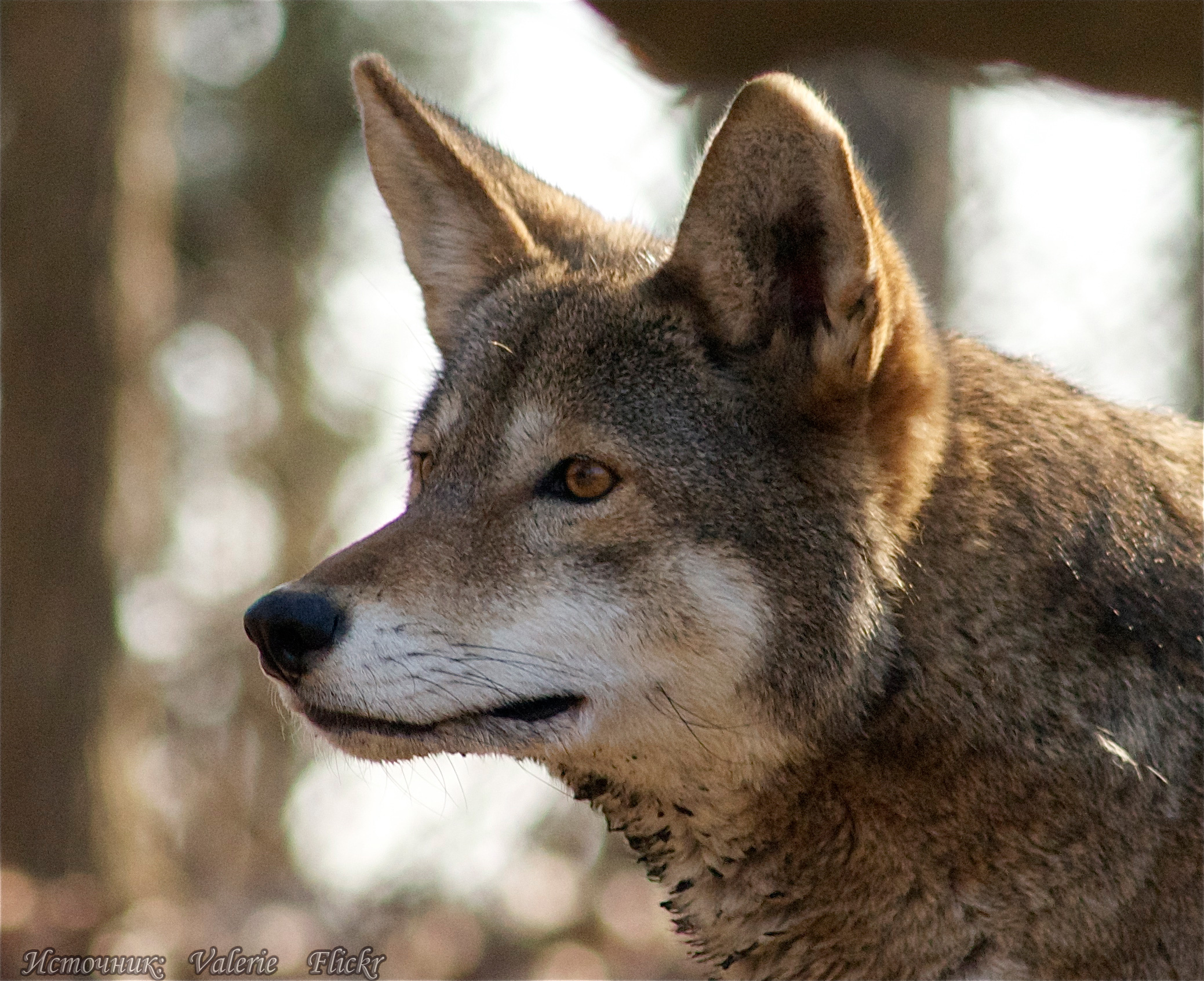
The red wolf (Canis rufus) is a canine native to the southeastern United States. Its size is intermediate between the coyote (Canis latrans) and gray wolf (Canis lupus).
The red wolf's taxonomic classification as being a separate species has been contentious for nearly a century, being classified either as a subspecies of the gray wolf Canis lupus rufus, or a coywolf (a genetic admixture of wolf and coyote). Because of this, it is sometimes excluded from endangered species lists, despite its critically low numbers. Under the Endangered Species Act of 1973, the U.S. Fish and Wildlife Service currently recognizes the red wolf as an endangered species and grants it protected status. Since 1996, the IUCN has listed the red wolf as a Critically Endangered species; however, it is not listed in the CITES Appendices of endangered species.
History
Red wolves were originally distributed throughout the southeastern and south-central United States from the Atlantic Ocean to central Texas, southeastern Oklahoma and southwestern Illinois in the west, and in the north from the Ohio River Valley, northern Pennsylvania, southern New York, and extreme southern Ontario in Canada south to the Gulf of Mexico. The red wolf was nearly driven to extinction by the mid-1900s due to aggressive predator-control programs, habitat destruction, and extensive hybridization with coyotes. By the late 1960s, it occurred in small numbers in the Gulf Coast of western Louisiana and eastern Texas.
Fourteen of these survivors were selected to be the founders of a captive-bred population, which was established in the Point Defiance Zoo and Aquarium between 1974 and 1980. After a successful experimental relocation to Bulls Island off the coast of South Carolina in 1978, the red wolf was declared extinct in the wild in 1980 to proceed with restoration efforts. In 1987, the captive animals were released into the Alligator River National Wildlife Refuge (ARNWR) on the Albemarle Peninsula in North Carolina, with a second release, since reversed, taking place two years later in the Great Smoky Mountains National Park. Of 63 red wolves released from 1987 to 1994, the population rose to as many as 100–120 individuals in 2012, but due to the lack of regulation enforcement by the US Fish and Wildlife Service, the population has declined to 40 individuals in 2018, about 14 in 2019 and 8 as of October 2021. No wild litters were born between 2019 and 2020.
Under pressure from conservation groups, the US Fish and Wildlife Service resumed reintroductions and increased protection. Reintroductions resumed in 2021. In 2022, the first wild litter was born since 2018. As of 2023, there are between 15 and 17 wild red wolves in ARNWR.
Description and behavior
The red wolf's appearance is typical of the genus Canis, and is generally intermediate in size between the coyote and gray wolf, though some specimens may overlap in size with small gray wolves. A study of Canis morphometrics conducted in eastern North Carolina reported that red wolves are morphometrically distinct from coyotes and hybrids. Adults measure 136–165 cm (53.5–65 in) in length, comprising a tail of about 37 cm (14.6 in). Their weight ranges from 20 to 39 kg (44-85 lbs) with males averaging 29 kg (64 lbs) and females 25 kg (55 lbs). Its pelage is typically more reddish and sparsely furred than the coyote's and gray wolf's, though melanistic individuals do occur. Its fur is generally tawny to grayish in color, with light markings around the lips and eyes. The red wolf has been compared by some authors to the greyhound in general form, owing to its relatively long and slender limbs. The ears are also proportionately larger than the coyote's and gray wolf's. The skull is typically narrow, with a long and slender rostrum, a small braincase and a well developed sagittal crest. Its cerebellum is unlike that of other Canis species, being closer in form to that of canids of the Vulpes and Urocyon genera, thus indicating that the red wolf is one of the more plesiomorphic members of its genus.
The red wolf is more sociable than the coyote, but less so than the gray wolf. It mates in January–February, with an average of 6-7 pups being born in March, April, and May. It is monogamous, with both parents participating in the rearing of young. Denning sites include hollow tree trunks, along stream banks and the abandoned earths of other animals. By the age of six weeks, the pups distance themselves from the den, and reach full size at the age of one year, becoming sexually mature two years later.
Using long-term data on red wolf individuals of known pedigree, it was found that inbreeding among first-degree relatives was rare. A likely mechanism for avoidance of inbreeding is independent dispersal trajectories from the natal pack. Many of the young wolves spend time alone or in small non-breeding packs composed of unrelated individuals. The union of two unrelated individuals in a new home range is the predominant pattern of breeding pair formation. Inbreeding is avoided because it results in progeny with reduced fitness (inbreeding depression) that is predominantly caused by the homozygous expression of recessive deleterious alleles.
Prior to its extinction in the wild, the red wolf's diet consisted of rabbits, rodents, and nutria (an introduced species). In contrast, the red wolves from the restored population rely on white-tailed deer, pig, raccoon, rice rats, muskrats, nutria, rabbits and carrion. White-tailed deer were largely absent from the last wild refuge of red wolves on the Gulf Coast between Texas and Louisiana (where specimens were trapped from the last wild population for captive breeding), which likely accounts for the discrepancy in their dietary habits listed here. Historical accounts of wolves in the southeast by early explorers such as William Hilton, who sailed along the Cape Fear River in what is now North Carolina in 1644, also note that they ate deer.
Range and habitat
The originally recognized red wolf range extended throughout the southeastern United States from the Atlantic and Gulf Coasts, north to the Ohio River Valley and central Pennsylvania, and west to Central Texas and southeastern Missouri. Research into paleontological, archaeological and historical specimens of red wolves by Ronald Nowak expanded their known range to include land south of the Saint Lawrence River in Canada, along the eastern seaboard, and west to Missouri and mid-Illinois, terminating in the southern latitudes of Central Texas.
Given their wide historical distribution, red wolves probably used a large suite of habitat types at one time. The last naturally occurring population used coastal prairie marshes, swamps, and agricultural fields used to grow rice and cotton. However, this environment probably does not typify preferred red wolf habitat. Some evidence shows the species was found in highest numbers in the once extensive bottom-land river forests and swamps of the southeastern United States. Red wolves reintroduced into northeastern North Carolina have used habitat types ranging from agricultural lands to forest/wetland mosaics characterized by an overstory of pine and an understory of evergreen shrubs. This suggests that red wolves are habitat generalists and can thrive in most settings where prey populations are adequate and persecution by humans is slight.
Extirpation in the wild
In 1940 the biologist Stanley P. Young noted that the red wolf was still common in eastern Texas, where more than 800 had been caught in 1939 because of their attacks on livestock. He did not believe that they could be exterminated because of their habit of living concealed in thickets. In 1962 a study of skull morphology of wild Canis in the states of Arkansas, Louisiana, Oklahoma, and Texas indicated that the red wolf existed in only a few populations due to hybridization with the coyote. The explanation was that either the red wolf could not adapt to changes to its environment due to human land-use along with its accompanying influx of competing coyotes from the west, or that the red wolf was being hybridized out of existence by the coyote.
Reintroduced habitat
Since 1987, red wolves have been released into northeastern North Carolina, where they roam 1.7 million acres. These lands span five counties (Dare, Hyde, Tyrrell, Washington, and Beaufort) and include three national wildlife refuges, a U.S. Air Force bombing range, and private land. The red wolf recovery program is unique for a large carnivore reintroduction in that more than half of the land used for reintroduction lies on private property. Approximately 680,000 acres (2,800 km2) are federal and state lands, and 1,002,000 acres (4,050 km2) are private lands.
Beginning in 1991, red wolves were also released into the Great Smoky Mountains National Park in eastern Tennessee. However, due to exposure to environmental disease (parvovirus), parasites, and competition (with coyotes as well as intraspecific aggression), the red wolf was unable to successfully establish a wild population in the park. Low prey density was also a problem, forcing the wolves to leave the park boundaries in pursuit of food in lower elevations. In 1998, the FWS took away the remaining red wolves in the Great Smoky Mountains National Park, relocating them to Alligator River National Wildlife Refuge in eastern North Carolina. Other red wolves have been released on the coastal islands in Florida, Mississippi, and South Carolina as part of the captive breeding management plan. St. Vincent Island in Florida is currently the only active island propagation site.
Captive breeding and reintroduction
After the passage of the Endangered Species Act of 1973, formal efforts backed by the U.S. Fish and Wildlife Service began to save the red wolf from extinction, when a captive-breeding program was established at the Point Defiance Zoological Gardens, Tacoma, Washington. Four hundred animals were captured from southwestern Louisiana and southeastern Texas from 1973 to 1980 by the USFWS.
Measurements, vocalization analyses, and skull X-rays were used to distinguish red wolves from coyotes and red wolf × coyote hybrids. Of the 400 canids captured, only 43 were believed to be red wolves and sent to the breeding facility. The first litters were produced in captivity in May 1977. Some of the pups were determined to be hybrids, and they and their parents were removed from the program. Of the original 43 animals, only 17 were considered pure red wolves and since three were unable to breed, 14 became the breeding stock for the captive-breeding program. These 14 were so closely related that they had the genetic effect of being only eight individuals.
In 1996, the red wolf was listed by the International Union for Conservation of Nature as a critically endangered species.
Relationship to humans
Since before European colonization of the Americas, the red wolf has featured prominently in Cherokee spiritual beliefs, where it is known as wa'ya (ᏩᏯ), and is said to be the companion of Kana'ti - the hunter and father of the Aniwaya or Wolf Clan. Traditionally, Cherokee people generally avoid killing red wolves, as such an act is believed to bring about the vengeance of the killed animals' pack-mates.