














The greater grison (Galictis vittata)


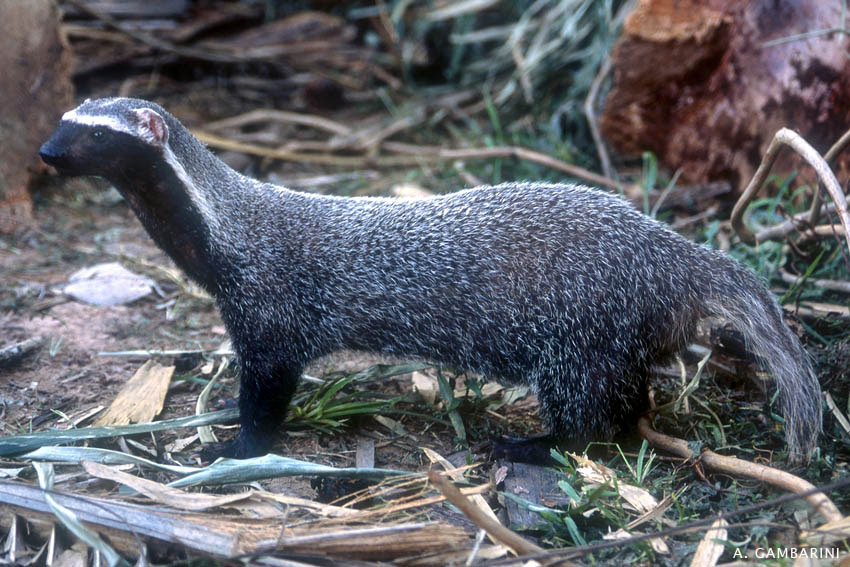
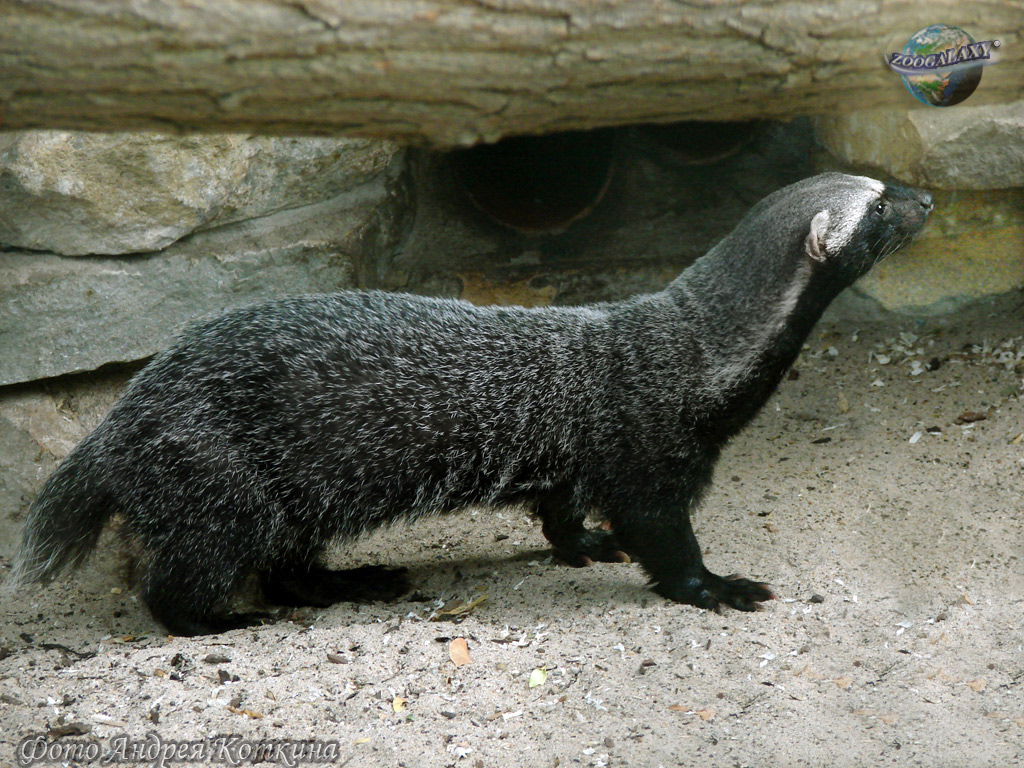
The greater grison (Galictis vittata) is a species of mustelid native to Southern Mexico, Central America, and South America.
Appearance
Galictis vittata, sometimes called simply or vulgarly as grison or ferret, is a species of mustelid.
Galictis vittata is a fairly large member of the family. Its body length varies from 47.5 to 55 cm, tail length from 13 to 19 cm, and weight from 1.5 to 3.8 kg. Galictis vittata has a slender body with short legs. Its back is smoky grey, while part of its muzzle below the forehead, the underside of the neck and the belly are black. A white stripe on the forehead extends down the sides of the neck to the shoulders.
Distribution and habitat
Greater grisons are native to North and South America, ranging from southern Mexico in the north, to central Brazil, Peru, and Bolivia in the south. They inhabit a wide range of forest and cerrado habitats, and are usually seen near rivers and streams. They are typically found at elevations below 500 metres (1,600 ft), but they may be found as high as 2,000 metres (6,600 ft) in some parts of the Bolivian Andes. In some regions, they may also be found in cultivated areas, such as plantations and rice paddies. Four living, and one fossil subspecies are recognised:
- Galictis vittata vittata – northern South America
- Galictis vittata andina – Peru and Bolivia
- Galictis vittata brasiliensis – Brazil
- Galictis vittata canaster – Central America and southern Mexico
- † Galictis vittata fossilis – Pleistocene Brazil.
Lifestyle and nutrition
The animal lives mainly during the day and, in some areas, also at night. During the warmer hours of the day, the predator usually rests. Its shelters are rock crevices, tree hollows and rhizomes, and abandoned armadillo burrows. This predator prefers to stay on the ground, but more rarely in trees or bushes. It swims well and sometimes dives, holding its breath for half a minute. In case of danger, Galictis vittata emits a warning sound, leaps to the side, raising its tail and spraying an odorous secretion from its anal glands. Galictis vittata feeds on small mammals, birds and their eggs, lizards, amphibians and fruits. It hunts alone, in pairs and in groups; it feeds on its prey in a specially designated area.
Reproduction
A gestation period of 39-40 days in Galictis vittata, after which one to four young are born. They are blind and covered with short hairs (however, in a pattern characteristic of adults). The eyes of the young open at 2 weeks and they are weaned at 3 weeks. After 4 months, they become adults.
Locals often keep Galictis vittata as a pet for rodent control.
Behaviour
Greater grisons are primarily terrestrial, although they can climb trees and swim well. They are mostly diurnal, and only occasionally active at night. They live alone or in pairs, with home ranges of at least 4.2 square kilometres (1.6 sq mi), and a very low population density, such that they are rarely encountered in the wild. They spend the night sleeping in cavities in hollow logs or beneath tree roots, or else in the abandoned burrows of other animals.
Little is known of their diet, although it consists largely of small vertebrates, such as fish, amphibians, birds, and other mammals. While hunting, they move in a zigzag pattern, making short bounds and occasionally stopping to look around with their heads raised and sniff the air. When moving more cautiously, they press their bodies close to the ground in a movement that has been described as 'snake-like'. They have been reported to respond to threats with a series of grunts that rise in intensity and frequency until they become rapid barks, and finally a single loud scream with their teeth bared.
Biology
Like many other mustelids, greater grisons possess anal scent glands that secrete a yellowish or greenish musk. Although not especially noxious in comparison with that of other species, this can be sprayed at attackers, as well as being used to mark the grison's territory.
Litters of up to four young are born from March to September, after a gestation period of 39 days. Newborn young weigh less than 50 grams (1.8 oz), and are initially blind, although with a short coat of hair already bearing the adult pattern. Their eyes open after two weeks, and they begin to eat solid food at three weeks, reaching the adult size in just four months. They have lived for at least ten years in captivity.