














Huillín, river otter, river cat, river wolf, Patagonian river wolf, water tiger (Lontra provocax or Lutra provocax)
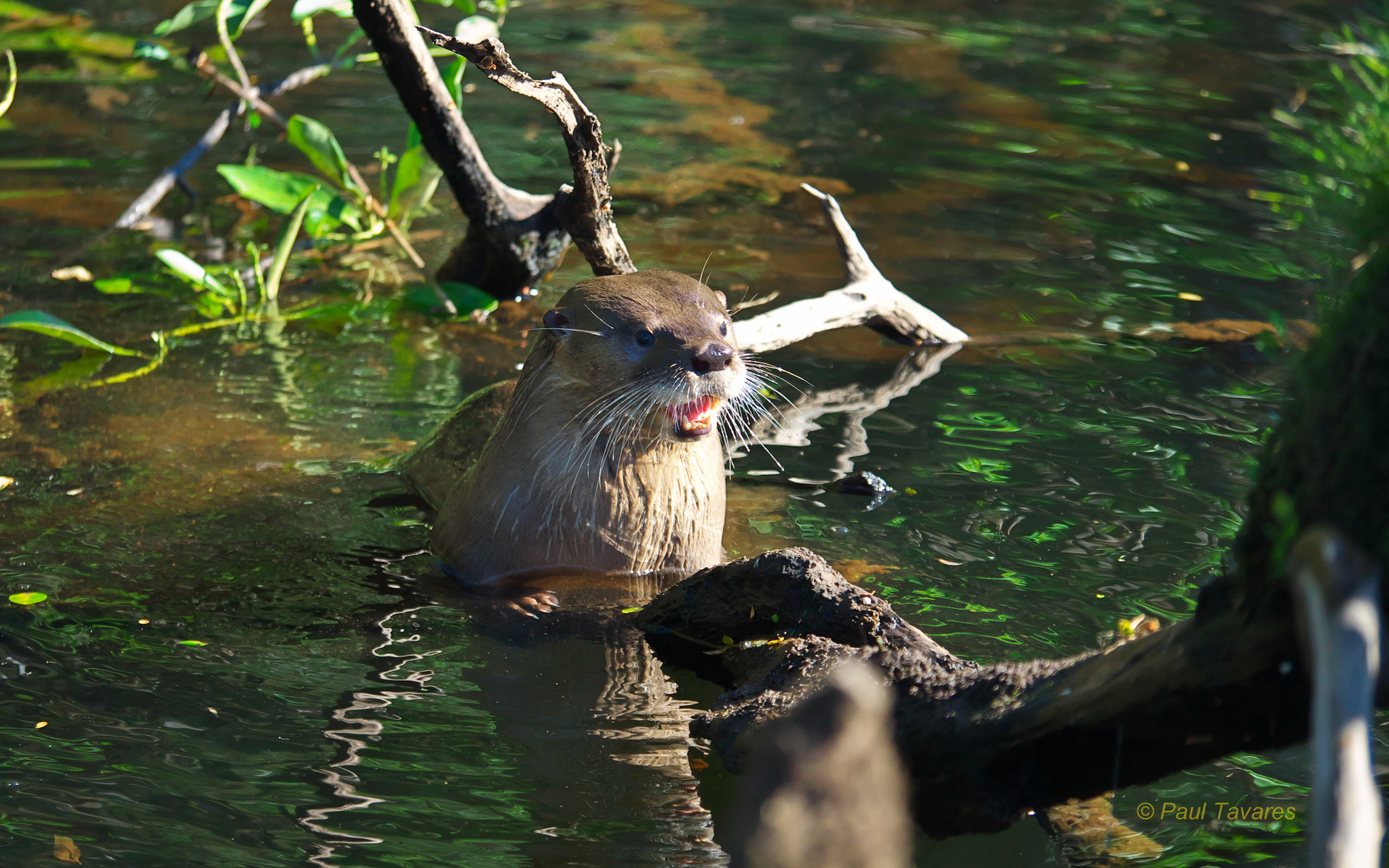
Lontra provocax or Lutra provocax, an animal species commonly known as huillín, river otter, river cat, river wolf, Patagonian river wolf, water tiger, aüilaf (yagán), yem'chen (aoniken) is an aquatic mammal belonging to the family of mustelids and the subfamily of lutrinos or otters, which inhabits aquatic environments in Chile and Argentina. It is currently listed as endangered (EN) by the IUCN, and is probably the species of otter with the smallest range in the world.
Description
The huillín is a species of otter, its elongated body generally measures between 1.10 and 1.30 metres including the tail, which measures 38 to 45 centimetres, and its weight reaches 6 to 15 kg. Its head is flattened dorsoventrally. It is recognisable by its dark brown velvety coat on the back and whitish on the belly. It has interdigital membranes on its hands and feet, which help it when swimming, and it also has strong nails on its toes. There is a characteristic concavity on each side of the dorsal edges of the rhinarium, small rounded pinnae and long, stiff vibrissae. In the male, the penis is completely covered with hair.
Distribution
Inhabits marine and freshwater environments of southern Chile and some isolated territories in Argentina. Freshwater habitats are located to the north of its geographic distribution. In Chile, the huillín was historically found from the Cachapoal River (34º S) to the Taitao Peninsula (46º S), continuously inhabiting the territory's lakes and rivers. However, changes in land use and human colonisation have reduced its distribution from the Imperial River (38º S) and south of it.
In Argentina, freshwater populations of the huillín were distributed from Neuquén Province (36º S) to Lake Buenos Aires (46º S), and were mostly found in Andean and steppe rivers. Nowadays, its presence is restricted to the Limay River basin, mainly within the Nahuel Huapi National Park.
On the other hand, the huillín is found in marine environments along the Pacific coast of Chile from 46º S to Tierra del Fuego, and in Argentina, it is only found on the island of Los Estados in the Fuegian Archipelago and in the Beagle Channel.3
It is probably the otter species with the smallest range in the world.
Physiology
The huillin has adaptations typical of the aquatic environment. Its elongated shape and flattened head give it hydrodynamics, as do its interdigital membranes and a tail as a propulsive organ. Their small ears and nostrils are plugged when submerged, but when swimming at the water's surface, nose, eyes and ears are exposed.
It has a large home range, and the huillin's breeding area is stipulated to be over 25 linear km of stream, river and lake banks. Their burrows and roosting sites are located close to water and in places with dense vegetation and many roots, inside cracked rocks or dug into the banks, submerged during floods or under shrubs and roots. Burrows form a cave system of between 1 and 4 openings, 25 to 50 metres from the water, and on the shoreline they conform to coastal rocks.
Males are usually solitary, except during mating, when they may be observed with a partner. Females form family groups with their young. Mating occurs in winter, and the female gives birth in spring, inside special burrows with camouflaged entrances. Newborns are blind, and spend their days in the burrow sleeping or nursing until they are two months old. They begin to see from the first month, swim from the third month, and are able to hunt from the fourth month. They leave the burrow during the first year of life, although they are not sexually mature until their second or third year, although many huillins die before reaching this last vital stage. Just over 1% of huillins survive beyond 6-10 years of age.
They have crepuscular and nocturnal activity, which is related to the nocturnal habits of some crustaceans, which are the basis of their diet. During the day they rest or migrate locally.
Ecology
Its preferred habitat is rivers, estuaries, lakes, estuaries, canals and rocky coastline. In freshwater environments, it is found in lakes or rivers with dense riparian vegetation, with many large-rooted trees, associated with terrestrial vegetation composed of canelo (Drymis winteri), hardwood (Maytenus magellanicus) and coihue (Nothofagus betuloides). In marine water areas, it prefers rocky areas such as rock walls or protected blocks not directly exposed to the Pacific Ocean, also in areas with abundant riparian vegetation and little anthropic pressure, which allows it to establish its burrows.
Its diet in freshwater environments is based on crustaceans. A more detailed study of their diet in the Boroa wetland (Araucanía Region, Chile) revealed that crustaceans make up 70% of their diet, more than 15% fish, and less than 5% amphibians, insects, molluscs, mammals, birds and other unidentified vertebrates. The river shrimp Samastacus spinifrons is the favourite crustacean of the huillin, accounting for over 45% of its diet, although the crustacean genus Parastacidae (14.4%), osteichthyan fish (13.3%), and the frog species Caudiverbera caudiverbera (2.6%) and plecopteran insects (>1%) are also an important part of its diet. Seeds of reed grass, cattail and quilmén may also form part of their diet (González, 2006).
There are differences in their diet between the dry and rainy seasons. In the rainy season, there is a decrease in fish prey, from more than 20% of their diet in the dry season to less than 7% during the rainy season. The diversity of prey is also greater during the dry season than in the rainy season. The huillin is considered to be a generalist diet species with opportunistic behaviour.
Three factors explain the huillin's range. Firstly, the presence of crustaceans, the main element of its diet. Secondly, human settlement, which restricts the huillin's habitat, and which could lead to negative changes in water visibility for the species. Finally, its interaction with the American mink Neovison vison.
Conservation
The huillin has been displaced from most of its freshwater range. The sharp decline in its presence in Chile is mainly due to the fragmentation and destruction of its habitat by humans, who have removed the riparian vegetation where the huillín builds its burrows and resting places, and who have polluted and modified the watercourse of rivers by dredging, building dams, and channelling water for agricultural use. Humans have also had negative effects on the huillín's presence through hunting practices, livestock disturbance, predation by dogs, and competition for food with salmonids escaped from Chilean fish farms.
There may be an interspecific competitive relationship between the invasive mustelid American mink (N. vison) for prey and habitat. However, the ability of mink to shift to a more terrestrial diet and to survive in different habitats in the presence of huillín has been shown to prevent direct competition. It has even been observed that the huillin would cause negative effects on mink by inducing changes in their feeding behaviour and activity pattern.
In Chile, the huillín was first catalogued with a conservation category in 1993, in the Red Book of Chilean Terrestrial Fauna, where it was considered an endangered species. Later, in 2007 and also in Chile, it was classified as endangered in its northernmost area (from O'Higgins to Los Lagos), where it lost a large part of its habitats due to habitat destruction and degradation and competition for food from introduced salmon, and without sufficient data in its southernmost area (from Los Lagos to Magallanes), meaning that it was considered a species with serious conservation problems but not differentiated as a vulnerable or endangered species, as in the north. Since 2009 there has been a National Conservation Plan for the Huillín in Chile.
In Argentina, it is considered an endangered species due to the isolation of its habitats.
Internationally, the huillín has been recognised as an endangered species (EN) by the IUCN Red List since 2004.