














The Chinese ferret-badger (Melogale moschata), the small-toothed ferret-badger
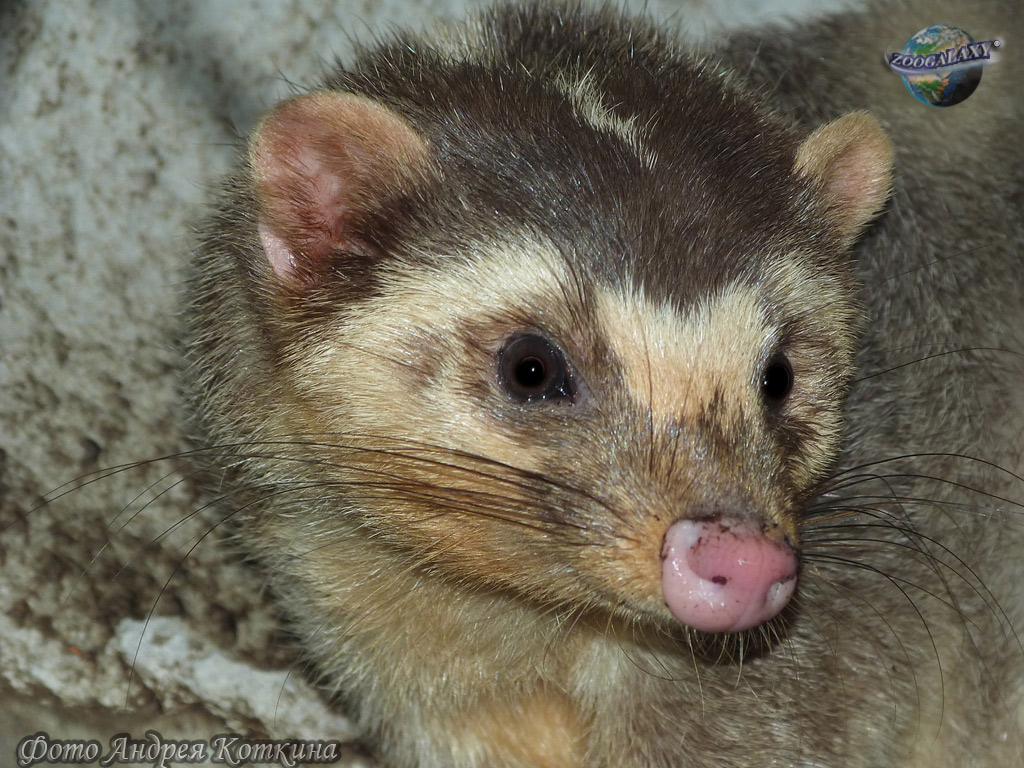
The Chinese ferret-badger (Melogale moschata), also known as the small-toothed ferret-badger is a member of the Mustelidae, and widely distributed in Southeast Asia. It is listed as Least Concern on the IUCN Red List and considered tolerant of modified habitat.
The Chinese ferret-badger is densely distributed from Northeast India north to Central China south to northern Indochina. The Formosan ferret-badger (Melogale subaurantiaca) of Taiwan was formerly considered conspecific, but is now thought to be a distinct species.
Description
Melogale moschata is very similar to Melogale moschata millsi, whose range is adjacent to the south. The body length is 30-40 cm and the tail 10-15 cm. The tail is slightly longer in Melogale moschata millsi. Body weight is about 0.8 to 1.6 kg. The body is slender and the muzzle is elongated. The colour of the coat varies from black to grey. On the head and neck, the main dark colour contrasts with white patches. The white areas on the head are generally less elongated than in Melogale moschata millsi. However, this feature is variable.
Another distinctive feature is the white stripe on the back of the head, which in the Burmese badger is less pronounced and usually reaches only to the shoulders. The tail is light brown with a white tip, relatively fluffy. The claws are well developed and females have two pairs of nipples. Compared to Melogale moschata millsi the teeth are much smaller.
Distribution
Melogale moschata is found in southern China, northern Myanmar, northeastern India, Vietnam and Laos, as well as on the islands of Hainan and Taiwan. The species is not considered endangered, but the exact population size is unknown. In Vietnam and Laos, where the range of Melogale moschata millsi borders that of Melogale moschata, identification of the species is difficult.
Subspecies
- Melogale moschata moschata moschata (Gray, 1831): southern China (Guangdong, Guangxi, Guizhou, Yunnan), Hainan Island and Laos.
- Melogale moschata ferreogrisea (Hilzheimer, 1905): Central China.
- Melogale moschata millsi (Thomas, 1922): northeastern Yunnan (China), northern Myanmar, northeastern India.
- Melogale moschata sorella (G. M. Allen, 1929): Fujian (China).
- Melogale moschata subaurantiaca (Swinhoe, 1862): Taiwan.
- Melogale moschata taxilla (Thomas, 1925): Vietnam.
Lifestyle
The natural habitat of the species is tropical and subtropical forests, grasslands and cultivated areas. The Chinese badger feeds on a wide variety of invertebrates (worms, insects), small mammals, birds, frogs, lizards, eggs and fruits. The animals are mainly active at night and in the evening. They lead a solitary terrestrial life, but can also climb trees. Little is known about the size of the site. A study in China revealed an average of about 11 hectares per animal.
Breeding
The breeding season for Melogale moschata begins in March, and the young appear to be born in May after a gestation period of approximately 60-80 days. The litter contains one to four blind but hair-covered young.
Diseases
The Chinese ferret-badger is associated with reported outbreaks of human rabies in southeastern China, which were first reported in 1997 and the most recent case in 2008. There have been no reported deaths in these cases; however, there is currently no rabies vaccine for ferret-badgers.
Threats
Ferret badgers are among the most hunted fur-bearing animals in Southern China, but maintain relatively high population densities in part due to their nearly-inedible meat and the low prices of their pelts.