














The white-striped dorcopsis or greater forest wallaby (Dorcopsis hageni)
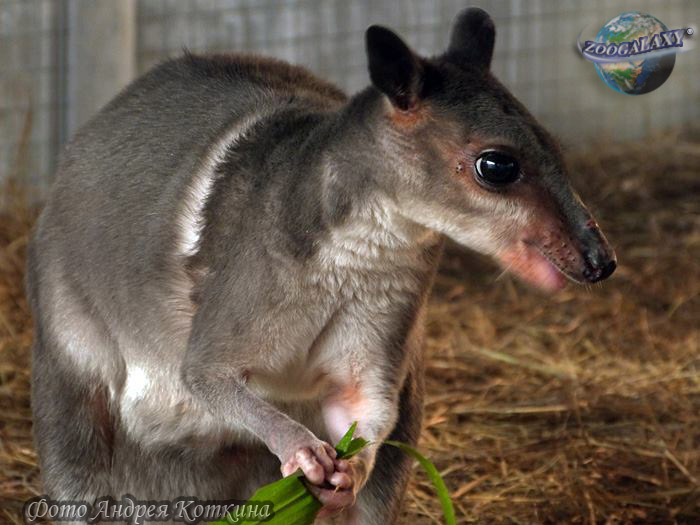
The white-striped dorcopsis or greater forest wallaby (Dorcopsis hageni) is a species of marsupial in the family Macropodidae. It is found in the northern part of West Papua, Indonesia and Papua New Guinea. It is a common species in suitable tropical forest habitat and the IUCN lists its conservation status as being of "Least concern".
Biology
The white-striped dorcopsis is a terrestrial herbivore and browser but has also been seen during daylight hours turning over flat stones in search of insects and other organisms. It also feeds on the fruiting bodies of fungi and may play a part in spreading spores and thus maintaining healthy mycorrhizal communities in the forest. Single naked young have been found in the pouches of females during the months of January and April.
Habitat and nutrition
One of its names, "bush kangaroo", Dorcopsis hageni, derives from the fact that its life is closely associated with thickets. Dorcopsis hageni prefers to live in the dense undergrowth of mountain or lowland forests, mainly in New Guinea, which is why they are also often called "New Guinea bush kangaroos".
Dorcopsis hageni are herbivores: they feed mainly on soft vegetation above and below ground (grasses, leaves, roots and fruits). In captivity, they feed on grass, hay, vegetables (carrots, turnips, boiled potatoes), apples, breadcrumbs, grain and mixed forage.
Lifestyle and description
Dorcopsis hageni is active mainly in the dark hours of the day. The average adult length ranges from 45 to 70 cm (not including the tail length of 30 to 45 cm), and males and females are about the same size. The head of Dorcopsis hageni is rather narrow and slightly pointed, the small ears are slightly rounded. The arch of the nostril is large and hairless. The tail tapers gently from the base to the tip (no hair on the tip). It acts as a support for the body while sitting and as a balance when the animal jumps. The hindquarters can be described as short.
The hair on the back varies from grey-brown to deep dark brown (dark patches can also be found on the back). The abdomen of Dorcopsis hageni, on the other hand, is light brown, grey or white. The hair on the back, from the rump to the back of the head, is directed forwards.
Reproduction
These animals reach sexual maturity at 15 months. The breeding season extends throughout the year and gestation lasts 30-45 days. During the breeding period, female Dorcopsis hageni carry a calf, which crawls into the mother's pouch, where it attaches to the nipple and grows until it is mature and ready to live an independent life. After the calf leaves the mother's pouch, the female is ready to mate again. The life expectancy of Dorcopsis hageni in captivity can reach 20 years.
Status
The white-striped dorcopsis has a range covering a large area of northern New Guinea and within that range it is common in suitable habitat. It is present in both primary and secondary forest and in some protected areas, and apart from some hunting for food, does not face any significant threats. The total number of animals is believed to be large and the population trend stable. For these reasons, the International Union for Conservation of Nature has listed it as being of "Least concern" in its Red List of Threatened Species.
It is hunted for human consumption in New Guinea.