














Dusky wallaby (Thylogale brunii)
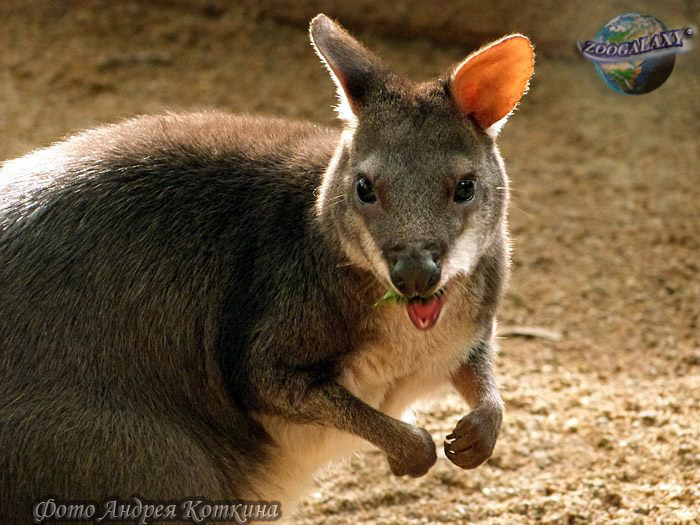
 The dusky wallaby (Thylogale brunii) is included in the IUCN Red List as a vulnerable species
The dusky pademelon or dusky wallaby (Thylogale brunii) is a species of marsupial in the family Macropodidae. It is found in the Aru and Kai islands and the Trans-Fly savanna and grasslands ecoregion of New Guinea. Its natural habitats are subtropical or tropical dry forests, dry savanna, subtropical or tropical dry shrubland, and subtropical or tropical dry lowland grassland. It is threatened by habitat loss.
Names
The scientific name of this pademelon honors Cornelis de Bruijn, the Dutch painter who first described it in the second volume of his Travels, originally published in 1711. There de Bruijn labeled his description with a common name then current, philander (“friend of man”). A later common name was the Aru Island wallaby.
It is known as kutwal (or kotwal) in the Kalam language of Papua New Guinea. François Valentyn records that Aru Islanders call it aijir and pelandoe; the Malays call it pelandok-aru ("Aru mousedeer") while the Ambonese call it koeskoes-aroe ("Aru cuscus") because it has a pouch like said animal.
Thylogale es un género de marsupiales diprotodontos de la familia Macropodidae. Sus siete especies son conocidas comúnmente como pademelones o ualabíes de matorral. Su nombre procede de la palabra badimaliyan, de la lengua aborigen Dharuk originaria de Port Jackson (región de Sídney).
Description and habitat
Thylogale brunii is a species of marsupial in the family Macropodidae. The marsupial is named after Cornelis de Bruyn (1652-1727), a Dutch artist who first brought Australian kangaroos to Europe in 1714. Thylogale brunii are the smallest members of the kangaroo family. The tail of Thylogale brunii is shorter and thicker than that of the wallaby, and its fur is sparser.
Thylogale brunii is common in the south and extreme southeast of the island of New Guinea, on the islands of Aru and Kai, and in the province of Papua in Indonesia. Its natural habitats are subtropical or tropical dry forests, degraded forests, dry savannahs, subtropical or tropical dry shrublands and subtropical or tropical dry grasslands.
Lifestyle and nutrition
Little is known about the lifestyle of this animal. Thylogale brunii is active at night and sleeps in dense undergrowth during the day. It feeds on grass and leaves along the forest edge.
Conservation status
Hunting by humans with dogs for meat is a serious threat. Hunting has led to the eradication of the species in the north-eastern part of its range, in the Port Moresby area. Thylogale brunii is listed as vulnerable on the IUCN Red List.