














The western red colobus (Piliocolobus badius), the bay red colobus, rust red colobus or Upper Guinea red colobus
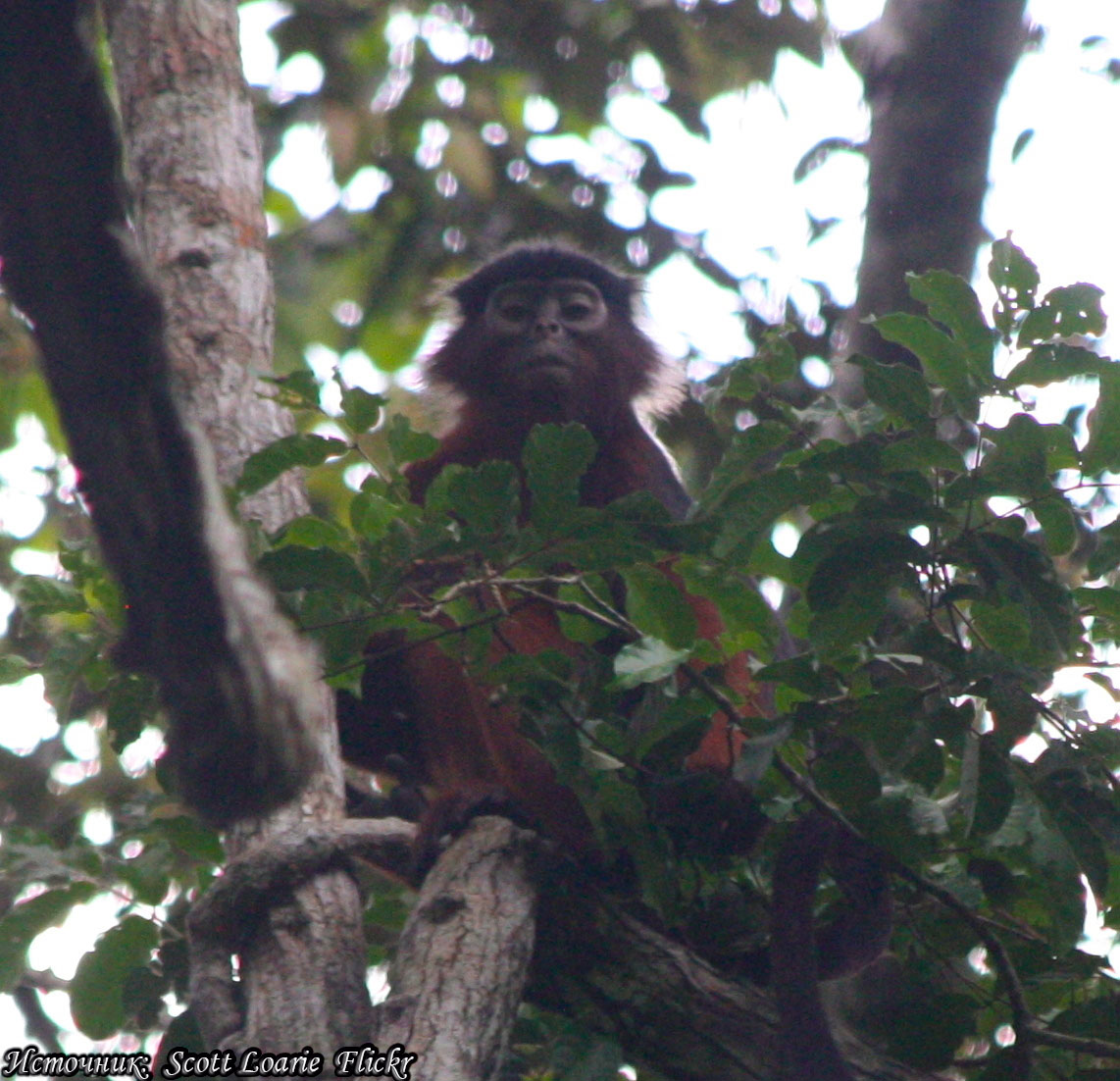

The western red colobus (Piliocolobus badius), also known as the bay red colobus, rust red colobus or Upper Guinea red colobus, is a species of Old World monkey in West African forests from Senegal to Ghana. All other species of red colobuses have formerly been considered subspecies of Piliocolobus badius. It is often hunted by the common chimpanzee. In 1994, western red colobus monkeys infected many chimpanzees with Ebola virus when the chimpanzees hunted the monkeys as prey.
Subspecies
According to Groves (2005) the Western red colobus has three subspecies, including the nominate:
- Bay red colobus, Piliocolobus badius badius;
- Temminck's red colobus, Piliocolobus badius temminckii;
- Miss Waldron's red colobus, Piliocolobus badius waldronae.
Piliocolobus badius waldronae is critically endangered, possibly even extinct. The other two subspecies are endangered. Under more recent taxonomies, these are generally considered separate species. Groves concurs with this revision, although not all primatologists agree.
Distribution
Piliocolobus badius is a species of Old World monkey. Piliocolobus badius is a species of monkey in the monkey family of the primate order, one of the species of the genus red colobus.
They inhabit the forests of West Africa from Senegal to Ghana.
Appearance
Sexual dimorphism is evident, females are slightly smaller than males. Males weigh between 9.1 and 12.2 kg and females between 6.8 and 9.1 kg. The length of the body varies from 45 to 67 cm, the length of the tail varies from 52 to 80 cm. The coat is brown, grey or black, and the head is brown or red. The pubic area is covered with white hair. The wool is of equal length all over the body. There are no thumbs, small tubercles instead. The toes are long, capable of grasping tree branches. There are three subspecies, which differ slightly in appearance. P.b. badius has a black forehead and outer surface of the thighs. Its nose is more protruding than that of the other subspecies. P. b. waldroni has a reddish outer surface of the thigh and forehead.
Lifestyle and nutrition
The species is found at all levels of the forest, from the ground to the treetops, up to 40 m high. Its diet consists mainly of leaves, as well as fruits and young shoots. Its stomach is multi-chambered and its digestive system is capable of efficiently digesting cellulose.
Reproduction
Female red colobus select their mates by migrating from one group to another. Males fight for females. When the female is ready to mate, her genitalia swell, which is a signal to the male.
Every two years, the female produces offspring, usually one, rarely two. Pregnancy lasts between 6 and 6.5 months.
Piliocolobus badius on the Red List
The population of Piliocolobus badius waldronae is critically endangered and may already be extinct. The other two subspecies are also threatened.