














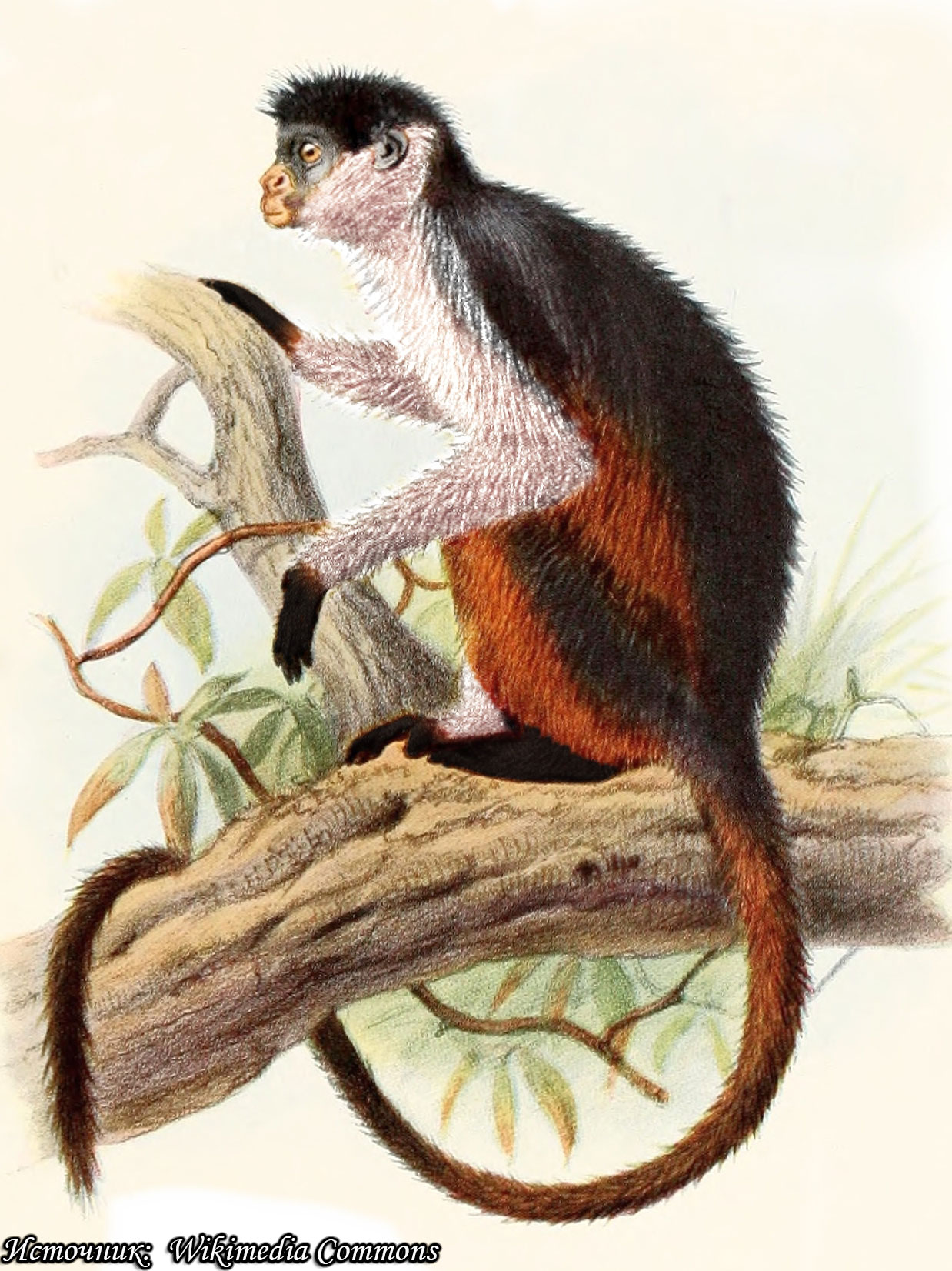
Pennant's colobus or Pennant's red colobus (Piliocolobus pennantii or Piliocolobus epieni)

Pennant's colobus or Pennant's red colobus (Piliocolobus pennantii or Piliocolobus epieni) is a species of tree-dwelling primate in the family Cercopithecidae. It is endemic to tropical Central Africa. Three subspecies have traditionally been recognised but its distribution is peculiarly disjunct and has been considered a biogeographical puzzle, with one population on the island of Bioko (Equatorial Guinea), a second in the Niger River Delta in southern Nigeria, and a third in east-central Republic of Congo. It is found in rainforests and marshy forests. It is threatened by habitat loss and hunting for bushmeat.
Taxonomy and etymology
Pennant's colobus was first described in 1838 by George Robert Waterhouse, curator at the Zoological Society of London's museum, and was named in honour of the naturalist and traveller Thomas Pennant. Three subspecies of this red colobus are traditionally recognized: The Bioko red colobus (Procolobus pennantii pennantii), the Niger Delta red colobus (Procolobus pennantii epieni) and Bouvier's red colobus (Procolobus pennantii bouvieri). However, Groves (2007) raised Piliocolobus pennantii epieni, and Piliocolobus pennantii bouvieri to Piliocolobus epieni and Piliocolobus bouvieri, respectively (this nomenclature has been followed here). Ting agreed that preliminary genetic evidence supported elevating Piliocolobus epieni at least.
The word "colobus" comes from Greek κολοβός, meaning "cut short", and is so named because of the significant reduction in size, or complete lack of an opposable thumb in comparison to other primates. To make up for this, they have four long digits that align to form a strong hook, allowing them to easily grasp branches and climb.
Description
Piliocolobus pennantii has a black back and orange-brown flanks and thighs. The abdomen and inner thighs are white. Feet and palms black. Tail reddish brown above, brown below, darker towards the tip. White sideburns on the muzzle.
Distribution
Piliocolobus pennantii is only found in the western part of the Niger Delta. It prefers swampy forests. It shares its range with other primate species, notably the red-bellied monkey, the red-headed mangobey, the great white-nosed monkey and the bush monkey.
Biology
Like other red colobus monkeys, Pennant's red colobus lives in troops which may consist of twelve to eighty individuals occupying a territory of 25 to 150 hectares. The troops have several males and a rather larger number of females and juveniles. They move through the canopy with agility, leaping from tree to tree and making use of the elasticity of the branches. The gestation period is probably about five months before a single infant is born.
Pennant's red colobus monkeys have been little studied but their diet is likely to be similar to that of other red colobus monkeys and consist mainly of fresh leaves supplemented by flowers, fruit and seeds. They have specialist teeth that can macerate leaves and break up tough but pliant unripe fruit and the seeds embedded in the flesh. Their multi-chambered stomach permits fermentation to occur and they can alternate between a leaf-based and a seed-based diet. They tend to select foliage with a high protein to fibre ratio and a low tannin content. One of their favourite food trees is Fleroya ledermannii.
Status
The nominate subspecies Piliocolobus pennantii pennantii is listed as "Endangered" by the IUCN in its Red List of Threatened Species because its range on the island of Bioko is less than 500 square kilometres (190 sq mi) and its population size is decreasing due to it being hunted for bushmeat. In 2006, the population on Bioko Island was estimated to be smaller than 5000 individuals. The Niger Delta red colobus is listed as "Critically Endangered" due to the fact that its habitat in the Niger Delta is being degraded by logging and the monkeys are hunted for food. Its population has declined by 80% during a period of thirty years. The Bouvier's red colobus has declined dramatically in numbers and is also listed as "Critically Endangered", although its status was elevated to "Endangered" in 2019. After not having been seen since the 1970s, it was considered possibly extinct until spotted and photographed in 2015 in Ntokou-Pikounda National Park in the Republic of the Congo (the first photograph of Piliocolobus pennantii bouvieri). The subspecies is likely on the brink of extinction.