














The Zanzibar red colobus or Kirk's red colobus (Piliocolobus kirkii)
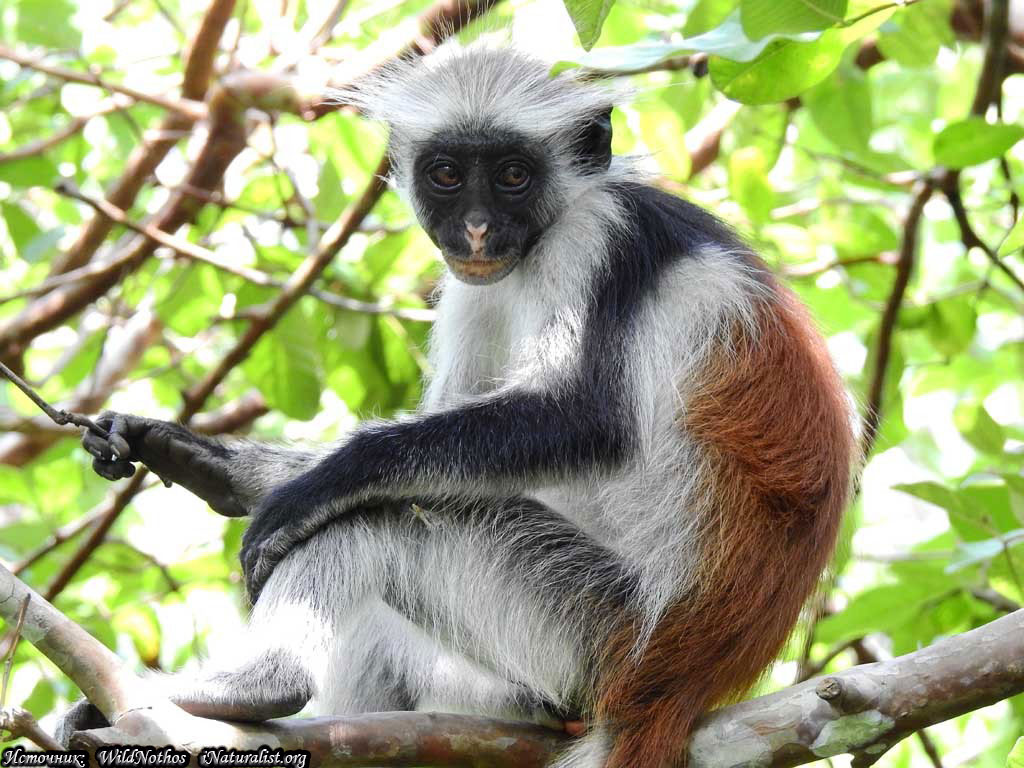

The Zanzibar red colobus (Piliocolobus kirkii) is a species of red colobus monkey endemic to Unguja, the main island of the Zanzibar Archipelago, off the coast of Tanzania. It is also known as Kirk's red colobus after Sir John Kirk, the British Resident of Zanzibar who first brought it to the attention of zoological science. It is now classified as an endangered species and in the mid-1990s was adopted as the flagship species for conservation in Zanzibar. The population is still decreasing, and conservationists are attempting to work with the local government to devise a proper, effective strategy to protect the population and habitat. Challenges include the species' habitat, which is limited to the archipelago. The species has been reclassified three times; it was previously in the genus Colobus, then in the genus Procolobus, and later in the genus Piliocolobus.
Evolutionary history and taxonomy
The Zanzibar red colobus, Piliocolobus kirkii, population on Zanzibar, represents a population of red colobus that is believed to have been isolated on the island after sea levels rose toward the end of the Pleistocene epoch. Furthermore, it is suggested through mitochondrial analysis, that phylogenetic groups within the red colobus have been genetically isolated from another since the Pliocene.
Examining cranial morphology has shown that Piliocolobus kirkii has diverged from mainland Piliocolobus to its own species. It has experienced an acceleration in morphological evolution of size which is suggested to be the result of insularity on the island and environmental pressures such as competition, habitat, predation and/or resource availability. There has been no evidence for population bottlenecks in the species.
The smaller cranium of Piliocolobus kirkii in contrast to the mainland colobus monkey, is consistent with Foster's rule (also known as the island rule) in which the original (larger) animal becomes smaller over time when there are limited resources. Males tend to have pedomorphic traits which include a shorter face, large orbits and an enlarged neurocranium. It is not certain how long ago and where this evolutionary change occurred.
Through molecular analyses, it is indicated that Piliocolobus kirkii is more closely related to the Udzungwa red colobus (Piliocolobus gordonorum) compared to other red colobus species. This analysis has also placed the divergence of Piliocolobus kirkii from its sister species Piliocolobus godronorum at about 600,000 years ago, which actually allows for an older evolutionary age compared to the previous assumption that it had become its own species around the last glacial period. The species has been reclassified twice; it was previously in the genus Colobus, and more recently in the genus Procolobus and then the genus Piliocolobus.
An alternative common name is Kirk's red colobus after Sir John Kirk (1832–1922), the British Resident of Zanzibar who first brought it to the attention of zoological science.
Description
Piliocolobus kirkii is a species of catarrhine primate belonging to the family Cercopithecidae. The colour of the back is orange or reddish. There is a black stripe along the arms and shoulders. The face is black. The basic colouring is light grey with grey. Sexual dimorphism is poorly developed. Males are slightly larger, weighing 12 kg or more, females weigh 8-10 kg; both sexes have the same colouring.
Distribution
Piliocolobus kirkii is endemic to Unguja, the main island of the Zanzibar archipelago. Most of the monkeys are found in the forests of Jozani Chwaka Bay, Zanzibar's only national park. The species is estimated to number between 2,000 and 3,000. In 1974, several monkeys were relocated to the neighbouring island of Pemba, where it is estimated that there are now up to 30 individuals. Piliocolobus kirkii live in groups, with adult males about half as numerous as females.
Reproductive peculiarities
One of the main reasons for the small population of Piliocolobus kirkii is the prolonged infancy of primates of this species. No other colobus species has such a long infancy period. The mother can suckle her young for up to 4 years, which causes hormonal changes in the lactating female, and she cannot conceive again during this time. As a result, birth intervals in Piliocolobus kirkii average 3.5 years, almost twice as long as in all other species of the genus.
Lifestyle and nutrition
Lifestyle - diurnal. Piliocolobus kirkii feeds on shoots, seeds, unripe fruit and young leaves. They rarely eat ripe fruit, as their stomachs are unable to digest sugar.
Conservation
A number of factors have contributed to the monkey's endangered status. First, an increase in deforestation has resulted in a significant reduction in resources and habitat; second, it is hunted for meat and pet markets. To counteract the decline in population, various attempts have been made to protect the species. In 1974, specimens were moved to Ngezi Forest on Pemba Island to try to re-establish the monkey's population. It had been found, however, that 20 years after the translocation to the island only one group of Zanzibar red colobus was found and with few sightings and interviews with locals, the population was estimated to be between 15 and 30 individuals. Researchers concluded that the group had certainly survived but did not increase in number possibly due to adverse relations with humans. Some locals in Pemba hold superstitions against the monkey because of the idea that it brings bad luck upon farmers. This may explain the reason that they have not significantly grown in population size.