














The black colobus or satanic black colobus (Colobus satanas)
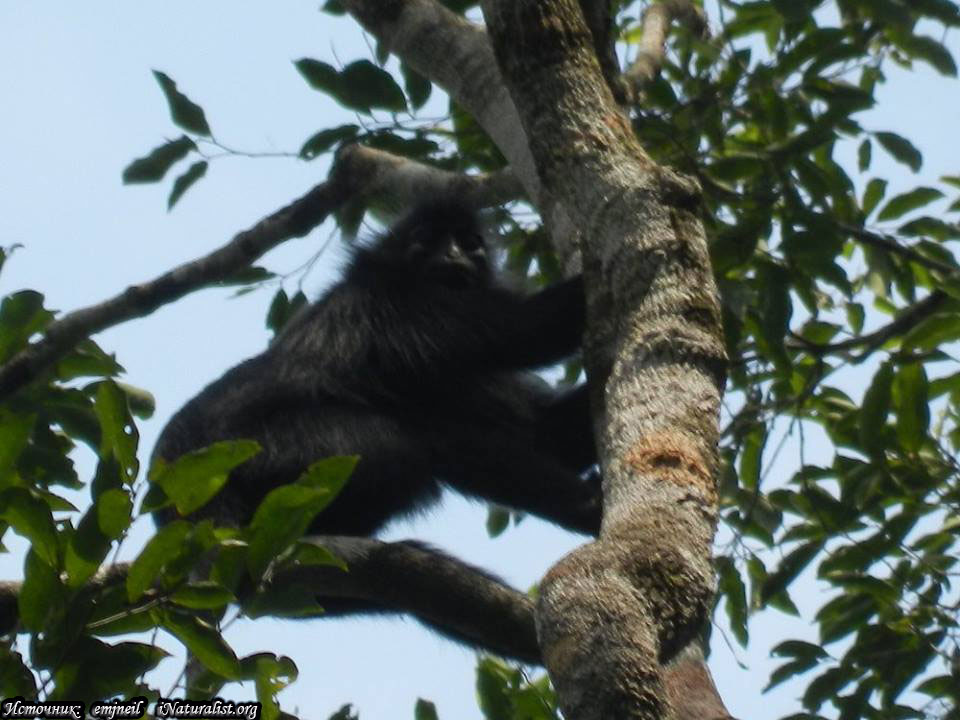

The black colobus (Colobus satanas), or satanic black colobus, is a species of Old World monkey belonging to the genus Colobus. The species is found in a small area of western central Africa. Black colobuses are large, completely covered with black fur, and like all other Colobus monkeys, do not have a thumb. The species has faced large declines in population due to habitat destruction and hunting by humans, and was consequently listed as Vulnerable on the IUCN Red List in 1994.
Taxonomy
The black colobus monkey is one of five recognised species in the genus Colobus. The black colobus is the oldest species in this genera and is thought to have diverged 3-4 million years ago.
There are two subspecies of black colobus monkey:
- Colobus satanas satanas – Bioko black colobus (Waterhouse, 1838);
- Colobus satanas anthracinus – Gabon black colobus (Le Conte, 1857).
Etymology
The word 'Colobus' comes from the Greek word for 'mutilated', as all Colobus monkeys only have a short stump where the thumb would be. The word 'satanas' means 'the accuser' or 'the devil' in Greek.
Description
Colobus satanas is a species of catarrhine primate of the family Cercopithecidae. This monkey is considered by some to be the most primitive of the colobus. Colobus satanas differs from other colobus by its lack of white hair on its head and tail. Its fur and skin are black.
The young are born with brown fur and become adults after a few months of age. Like other colobus, Colobus satanas has enlarged salivary glands and sciatic calluses.
The thumbs are reduced. Limbs and toes are long, hind limbs longer than forelimbs.
Large teeth, adapted for chewing seeds and hard nuts.
Males are slightly larger than females. The weight of an adult animal ranges from 4 to 14 (11 on average) kilos. Body length is 50 to 70 cm, tail length 62.5 to 88 cm.
Distribution
Found in West Africa, from the Sanaga River in Cameroon south to Equatorial Guinea and Gabon. Its range extends as far east as northwestern Congo and west to Bioko Island, off the coast of Cameroon. It inhabits primary and secondary rainforests, preferring the upper levels of the forest.
Lifestyle and nutrition
Colobus satanas are diurnal animals. They are inactive and spend most of their time sitting on the upper branches of trees. They form groups of 5 to 15 individuals, sometimes forming larger herds. They lead a semi-nomadic life, often moving from place to place in search of food. They rarely come down to the ground.
Their diet consists mainly of nuts and seeds, supplemented by fruits and young leaves. Their stomach has four chambers and is adapted to digest large amounts of cellulose.
Social structure
Black colobus monkeys live in multi-male groups of 10-20 individuals. The species is territorial and will make loud calls to warn other groups away from the area in which they are feeding. The black colobus call is distinctive from other primate species and sounds like a loud 'sneeze' followed by a roaring noise. Black colobus groups are sometimes joined by single male crested mona monkeys (Cercopithecus pogonias). These individuals take part in black colobus grooming and socialising and are thought integrate themselves into black colobus groups for protection. Colobus monkeys have been known to respond to crested mona monkey alarm calls.
Activity
Black colobus monkeys are diurnal and spend around 60% of their time resting. The remaining part of their day is spent feeding, socialising and moving. Black colobuses have large home ranges and will move up to 850 metres each day in search of food.
Reproduction
Colobus satanas is polygamous. Frequent clashes between males for the right of possession of the female. There is no defined mating season. Females are in heat for about a month, and pregnancy lasts about 200 days. There are usually one, rarely two, offspring in a litter. Males reach sexual maturity at about 6 years of age, females two years earlier.
Conservation
The black colobus monkey is one of the most threatened primate species in Africa and is currently listed as Vulnerable on the IUCN Red List. This is because the species’ population has declined by over 30% in the past 30 years. The subspecies C.s.satanas is classified as Endangered as its population has declined by over 60% in the last 30 years. The black colobus monkey is now only found in areas which cannot be easily accessed by humans.
The species has faced population declines due to logging and illegal hunting for the fur trade which began in the 19th century. Due to improved roads and increased wealth in the area, commercial hunting for the species has become more profitable. Today, black colobus monkeys are mainly traded for their meat and account for 20% of the bushmeat sold in Malabo, the capital of Equatorial Guinea. One adult black colobus carcass is sold for around US$20.42.
The black colobus monkey is listed under Appendix II of CITES, which restricts international trade of the species. The species is also listed under Class B of the African Convention on the Conservation of Nature and Natural Resources. Further information and data is needed to in order to help conserve the species. Conservation programs such as the Bioko Biodiversity Protection Program aim to work with local people to learn more about the black colobus monkey and protect it from extinction.