














Gerp's mouse lemur (Microcebus gerpi)
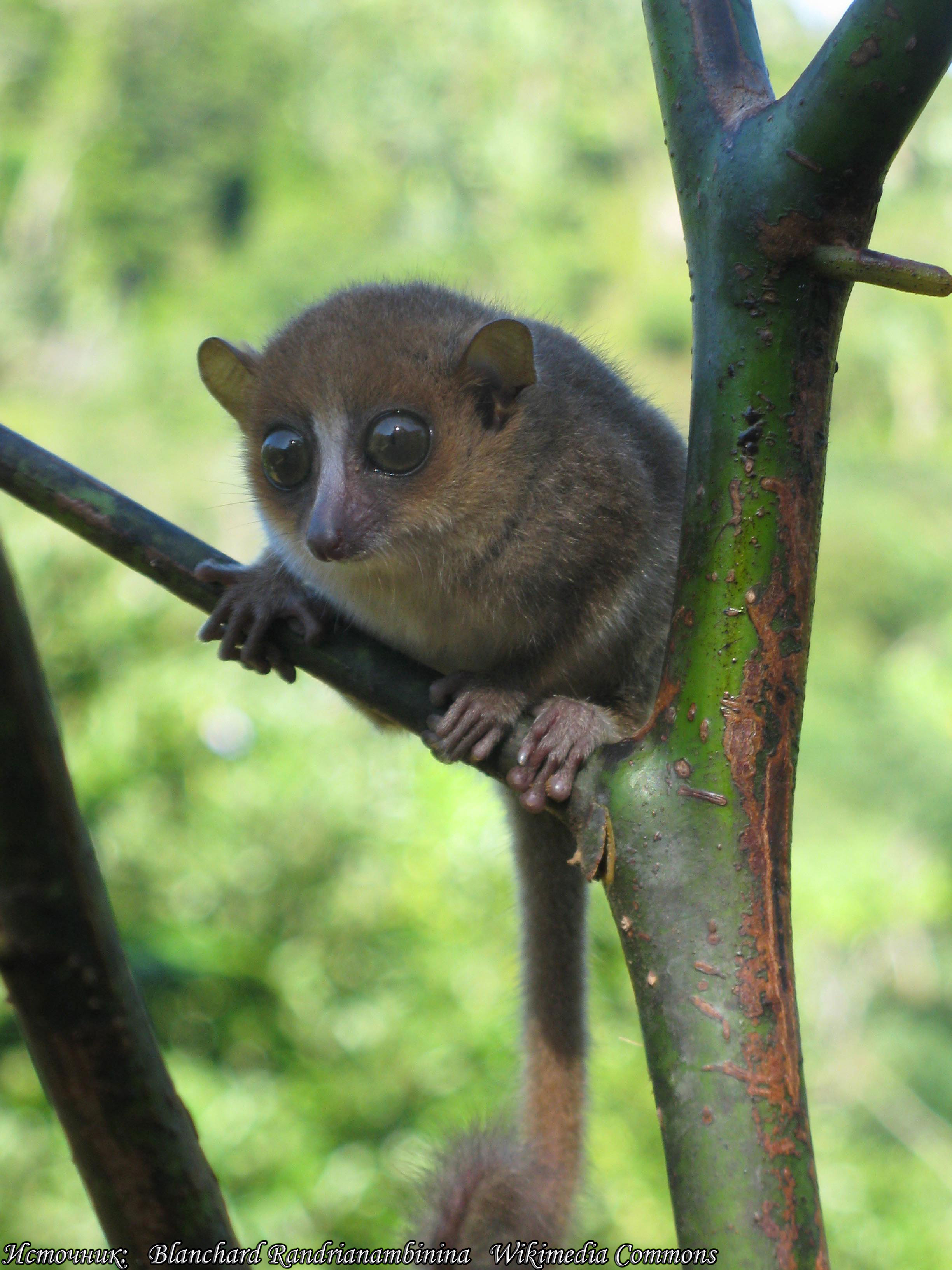
 Gerp's mouse lemur (Microcebus gerpi) is included in the IUCN Red List as "critically endangered"
Appearance
Gerp's mouse lemur (Microcebus gerpi) is a species of strepsirrhine primate inhabiting the Sahafina forest in eastern Madagascar, near Mantadia National Park. Microcebus gerpi has a body length of 7.7 to 9.3 cm and a tail of 14 to 15 cm. The weight ranges from 48 to 90 g.
The body colour is brownish-grey with a reddish-brown head. The colour around the eyes is darker, with a white stripe between the eyes. Ears small, dark brown at the edges. An indistinct red-brown stripe runs down the centre of the back.
The colour of the abdomen varies from light grey to creamy white from the lower part of the neck to the genital area (including the scrotum). The forearms and legs are darker than the rest of the body.
The forefeet and hind legs are pinkish brown, covered with whitish-grey hairs.
The long tail is covered with dense brownish-grey hairs. It is darker on top than underneath. Fat may accumulate on it. The undercoat is dense and short, while the hairs are much finer.
The species has morphological and genetic differences with its closest relative Microcebus jollyae. For example, it has a significantly longer tail. Unlike another closely related species, Microcebus lehilahytsara, Microcebus gerpi is larger and heavier, has a longer and broader head, a longer snout, a longer distance between the eyes, longer hind limbs, a longer third toe and a longer tail.
Distribution
Microcebus gerpi inhabits the Sahafina rainforest in eastern Madagascar, 50 km from Mantadia National Park. The confirmed range is extremely small: a patch of virgin forest covering only 15.6 km², surrounded on all sides by secondary forest that has grown on former rice fields. The potential range is about 7,600 km², but most of this area is currently deforested.
Distribution and habitat
Gerp's mouse lemur has only been identified in the Sahafina Forest in eastern Madagascar, about 58 km (36 mi) east of Mantadia National Park, 87 km (54 mi) south of the city of Toamasina, and 18 km (11 mi) from the Indian Ocean. The forest fragment is about 15.6 km2 (6.0 sq mi) and is surrounded by secondary forest growing in areas previously cut for rice cultivation (known locally as savoka).
The Sahafina Forest ranges from 29 to 230 m (95 to 755 ft) above sea level, whereas nearby Mantadia National Park, home of its closest neighbouring mouse lemur population (Goodman's mouse lemur), ranges from 900 to 1,200 m (3,000 to 3,900 ft) above sea level. No major rivers separate these highland and lowland forests and their respective mouse lemur populations. The initial study did not conclude whether the large Rianila River or one of the smaller rivers-the Ivonoro and Onibe-further north acts as a species boundary between Gerp's mouse lemur and Simmons' mouse lemur (M. simmonsi) to the north. Approximately 160 km (99 mi) the south lies the Mangoro River, a very large river that acts as a biogeographic barrier for many species. In 2010, a genetically distinct form of mouse lemur was sequenced from Marolambo, 25 km (16 mi) south of the river. The geographic range of Gerp's mouse lemur is unlikely to extend south of this river, but more studies are needed to confirm this. In total, the area between the rivers to the north and south, the highlands to the west, and the ocean to the east is no larger than 7,600 km2 (2,900 sq mi) (smaller than the island of Puerto Rico) and this is the likely extent of its geographic range.
Conservation status
There are no protected areas within the known geographic range of Gerp's mouse lemur. Because it lives in lowland forests, which are more likely to be converted into agricultural land relative to highland rainforests, it faces an elevated conservation risk. Of the 7,600 km2 (2,900 sq mi) of its potential geographic range, only very small parts remain forested.