














The Marohita mouse lemur (Microcebus marohita)
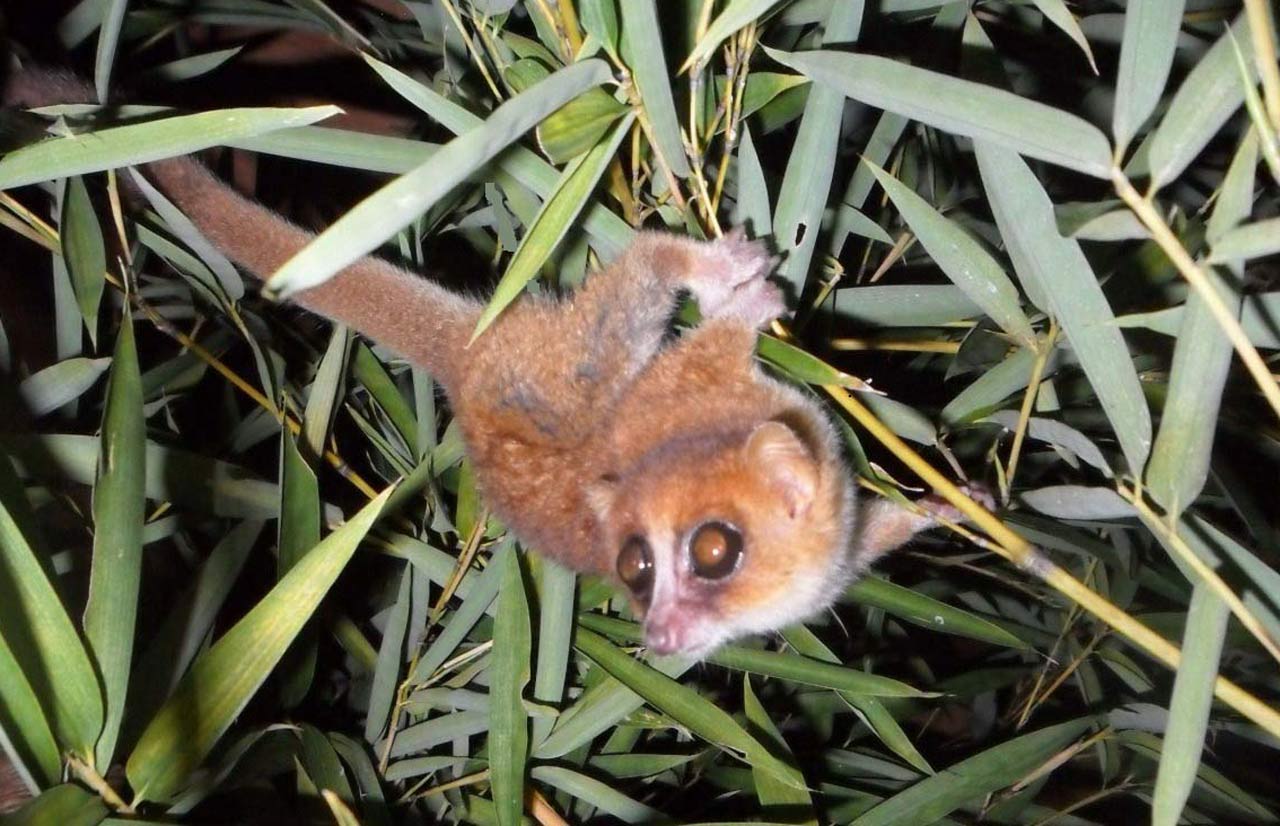 Фото Peter Kappeler


The Marohita mouse lemur (Microcebus marohita) is a species of mouse lemur known only from the Marohita Forest in eastern Madagascar, near the village of Marolambo.
Microcebus marohita is a species of mouse lemur. Endemic to Madagascar. First discovered in 2003 in the eastern part of the island and described in 2013, along with another mouse lemur, Microcebus tanosi. It is one of the largest members of its genus and is found in the same areas as Microcebus lehilahytsara, Microcebus simmonsi and Microcebus rufus, all four species being very similar in appearance.
Appearance
The coat on the back is reddish brown, with a black stripe running down the back. The coat is grey on the belly and chest, with a dark grey undercoat. The length of the body is 275 to 286 mm and the length of the tail 133 to 145 cm. The ears are short, about 18 mm long. The hind limbs are relatively long, averaging 35 mm.
It is probably the largest mouse lemur, weighing up to 89 grams. Females weigh 20% more than females of other species of murine lemurs previously considered the largest.
Distribution and habitat
The Marohita mouse lemur has only been found in the Marohita Forest, located within the more extensive Marolambo Forest. Its distribution outside of Marohita Forest is unknown. Four other mouse lemur species have been found nearby: the highland species, Goodman's mouse lemur, and the lowland species, Gerp's mouse lemur, both described less than ten years earlier, are found north of the Mangoro River, while Jolly's mouse lemur (M. jollyae) and the brown mouse lemur are found south of Marolambo.
Taxonomy and phylogeny
The first specimens of Marohita mouse lemur (Microcebus marohita) were collected by biologist Rodin Rasoloarison during field work in December 2003. At the time, he captured three mouse lemurs at Marohita Forest in the Toamasina Province of eastern Madagascar, near the village of Marolambo. These were prepared as biological specimens, including skins, skulls, and tissue samples, with the required permits from the government of Madagascar. The Marohita mouse lemur was described concurrently with the Anosy mouse lemur (Microcebus tanosi) in 2013 by Rasoloarison and researchers David Weisrock, Anne Yoder, Daniel Rakotondravony, and Peter M. Kappeler using molecular analysis. The Marohita mouse lemur belongs to the genus Microcebus within the family Cheirogaleidae. The holotype was collected on 2 December 2003 at Marohita Forest. Its species name, marohita, refers to the forest in which it was found and means "many views" in the Malagasy language.
Despite living near the Goodman's mouse lemur (Microcebus lehilahytsara), Simmons' mouse lemur (M. simmonsi), and the brown mouse lemur (Microcebus rufus), Rasoloarison et al. reported no indications of gene flow between these four sympatric species. The population at Marohita Forest is considered a distinct species using the metapopulation lineage concept of species. It is nearly identical in appearance to the other eastern mouse lemurs, which are known for being cryptic species.
Conservation status
The species has been granted Near Threatened status by the International Union for Conservation of Nature. The main threat to the population is habitat destruction.