














Sibree's dwarf lemur (Cheirogaleus sibreei o Microcebus myoxinus)
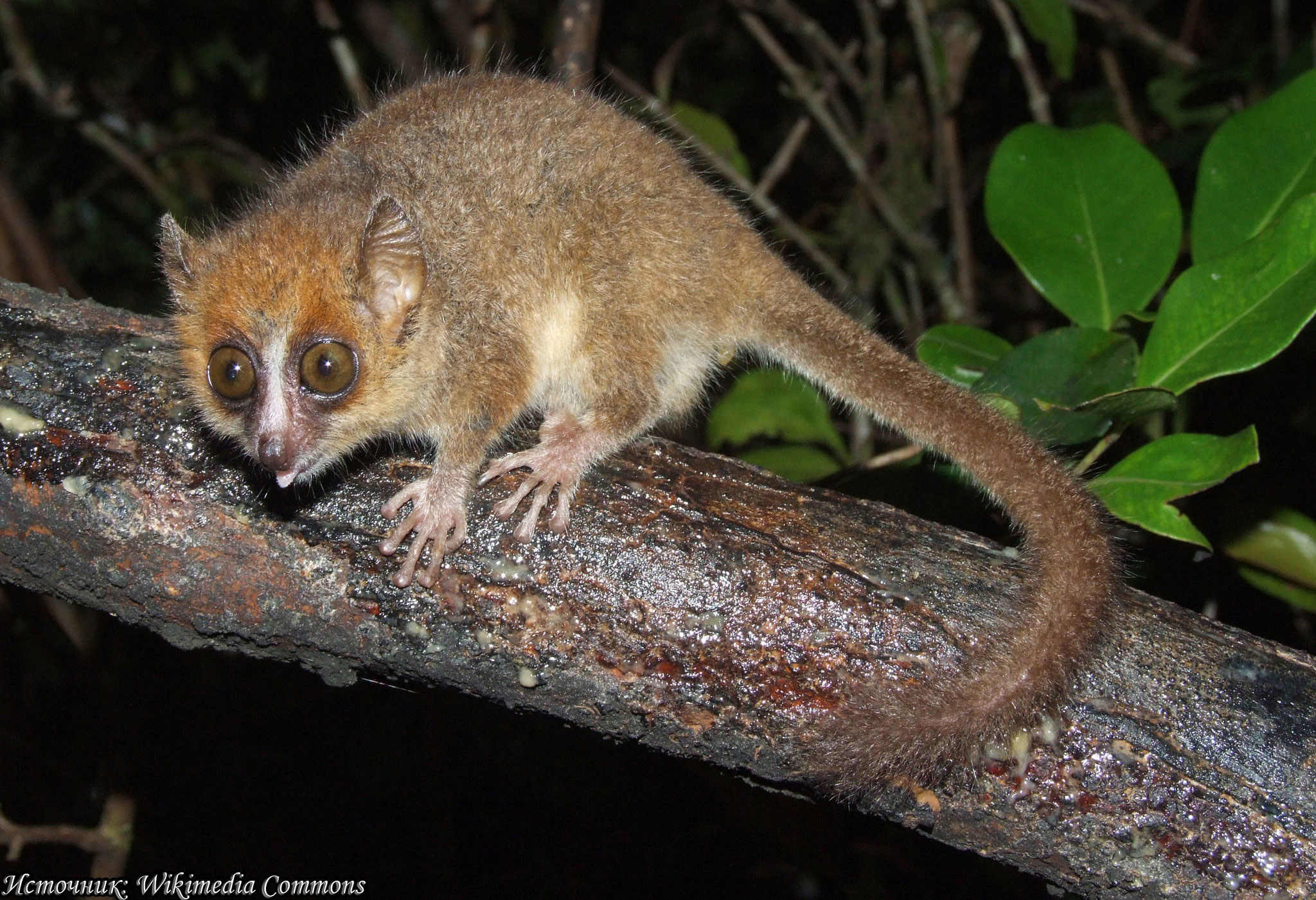

Sibree's dwarf lemur (Cheirogaleus sibreei or Microcebus myoxinus) is a small nocturnal lemur endemic to Madagascar.
The name of this dwarf lemur commemorates the English missionary and naturalist James Sibree (1836-1929).
Appearance
The pygmy mouse lemur or Peters' mouse lemur (Microcebus myoxinus) is a species of strepsirrhine primate in the family Cheirogaleidae. It is the smallest of the mouse lemurs and one of the smallest primates (the main competitor for this title is the pygmy toad).
It weighs about 50 grams and has a body length of about 20 centimetres, of which 10 centimetres is the tail. It has a reddish-brown back and creamy white abdomen. It was first described in 1852, but due to its small size and nocturnal lifestyle, the species was not found again until 1993.
The body size of Microcebus myoxinus proper is that of the large rat. The tail is shorter (16.5-25 cm) than the head and trunk and very thick at the base. The muzzle is short and the ears are almost naked and webbed.
Colour of coat brownish red or grey (some with white markings), with dark rings around the eyes, accentuating the large size of the eyes. Microcebus myoxinus has an elongated navicular and metacarpal bone, like the African galago.
They move in a similar way, jumping.
Habitat
Found in the arid deciduous and mixed forests of western Madagascar, in the Kirindi Natural Park, where it was found. The range is believed to be wider, but this has not been confirmed. Food: spiders, insects, fruit, nectar, leaves, less frequently small frogs and lizards.
Microcebus myoxinus inhabits tropical forests. They nest in tree hollows or bushes and make nests in dry leaves. They can be found in the tops of tall trees and are often seen in reed thickets on the shores of lakes. They climb trees like squirrels and hop on the ground, active at night, hunting insects and possibly other small animals, also eating fruit. Microcebus myoxinus sleeps in a ball. Hibernates during the dry season.
Lifestyle
Microcebus myoxinus occurs solitary and in pairs, but in captivity may be kept in large groups. They sleep huddled in tree hollows or in nests made of grass, small twigs and leaves. They hibernate in the same way, and hibernate during the dry season. In the favourable (rainy) period they accumulate fat in various parts of their body, especially at the base of the tail, and in the prolonged torpor they deplete their fat reserves.
In captivity, they are quite aggressive, but there are also some that are more docile.
Reproduction
Pregnancy of Microcebus myoxinus proper lasts about 70 days, the female giving birth to 2-3 blind young weighing 18-20 g, with their eyes open on the second day of life. The mother carries her young in her mouth. Breeding season is from May to September in northern latitudes (in captivity) or from December to May in Madagascar.
Gestation lasts 59-62 days, and 1-3 very small calves are born, weighing only 3-5g. At 15 days of age, they begin to climb. They become fully independent at 60 days and reach sexual maturity at 7-10 months.
They breed relatively easily in captivity.