














The golden-brown mouse lemur (Microcebus ravelobensis), the (Lac) Ravelobe mouse lemur
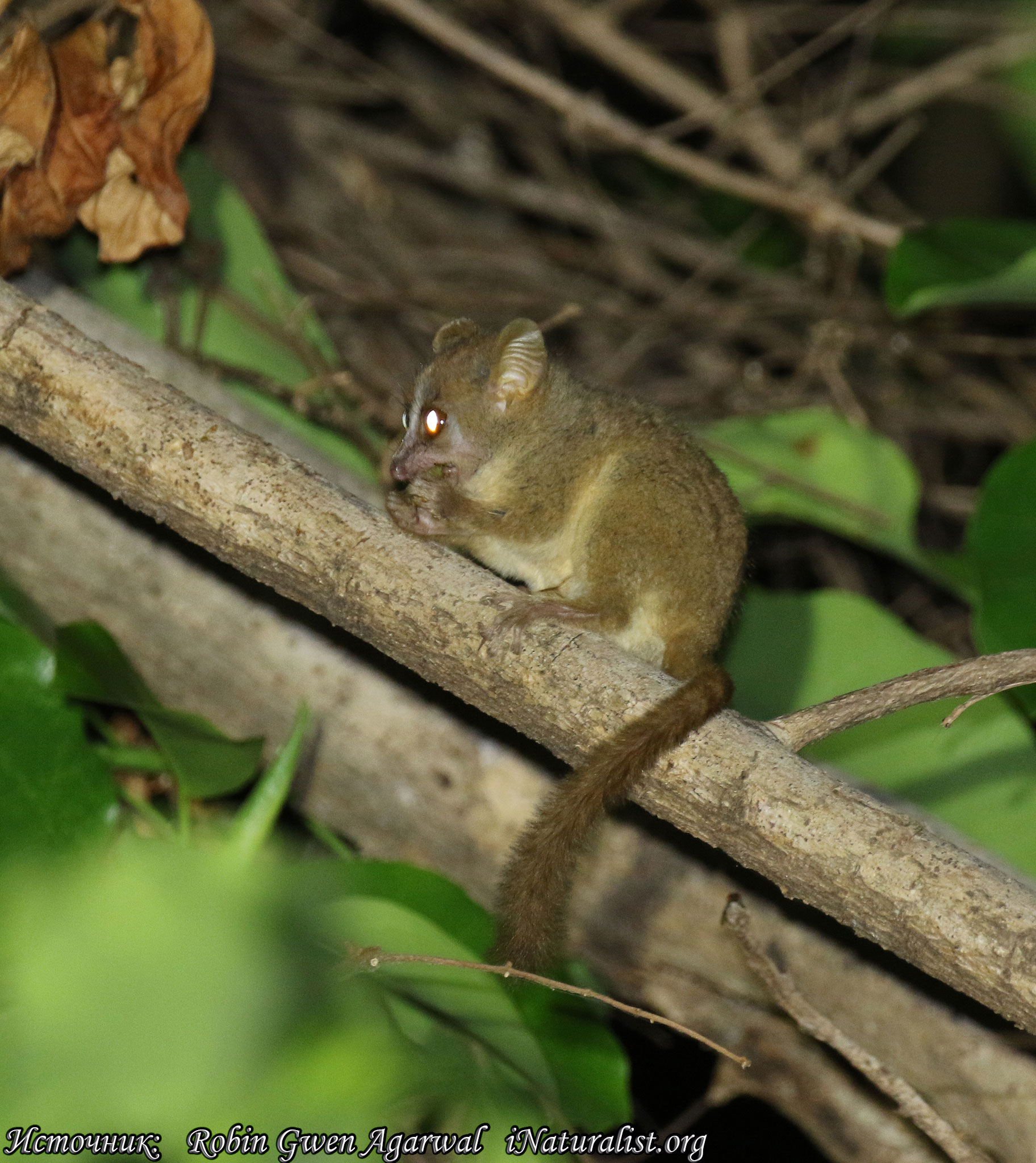

The golden-brown mouse lemur (Microcebus ravelobensis), also known as the (Lac) Ravelobe mouse lemur, is part of the Cheirogaleidae family, and the smallest species of lemur. It is arboreal, nocturnal and usually social. It get its name from the colour of its body. Like several other mouse lemurs, like the brown mouse lemur (Microcebus rufus), it is a small primate that has a brown dorsal side and a whitish-grey for its ventral side of the body. All lemurs live in Madagascar. This species was discovered in 1994.
Appearance
The golden brown mouse lemur (Microcebus ravelobensis), is a species of primate, belonging to the family Cheirogaleidae.
This species was identified as a separate species on the basis of a combination of morphological and genetic traits. The coat is golden brown on the back and light yellow on the belly. In the centre of the muzzle there is a white stripe from the forehead to the nose. Weight 40 to 70 grams, depending on the season. Externally, the species resembles the grey mouse lemur (Microcebus murinus), but has a longer and thinner tail. Unlike Microcebus murinus, these primates move through the forest at a fast pace.
Distribution
Occurs in the dry deciduous forests of Ankarafantsika National Park in north-western Madagascar. It shares its range with the grey mouse lemur, with which it has a sympatric relationship. The two species occupy different ecological niches in their range.
Microcebus ravelobensis prefers low, damp places near water sources, while Microcebus murinus is more often found in the highlands and drier parts of the forest, further away from water sources.
Life style
Nocturnal animals. They sleep on tree branches or in nests of lianas and fallen leaves. The habitat is distributed among family groups that do not show territorial behaviour. In a 2009 study, both lactating and non-lactating females were shown to build nests. Nest building takes place during the early evening and lasts approximately one hour. Nests are made of small twigs and fallen leaves.