














Coquerel's giant mouse lemur (Mirza coquereli), Coquerel's dwarf lemur or the southern giant mouse lemur
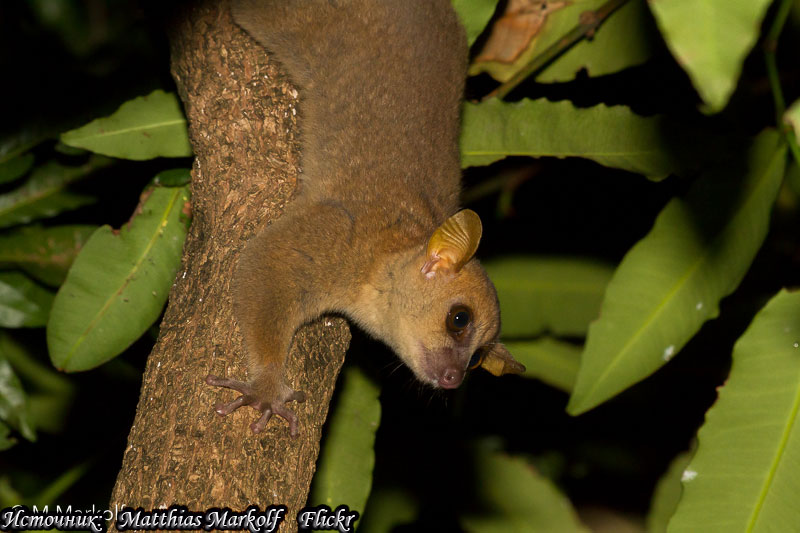

Coquerel's giant mouse lemur (Mirza coquereli), also known as Coquerel's dwarf lemur or the southern giant mouse lemur, is a small nocturnal lemur endemic to Madagascar. This species can be found in parts of the Madagascar dry deciduous forests.
Appearance
Mirza coquereli is a nocturnal species of lemur in the family Cheirogaleidae (dwarf lemurs or mouse lemurs).
It is one of two species in the genus of giant mouse lemurs.
Small primates, with a body length of 20 to 25 cm. Tail length 30 to 33 cm. Weight between 290 and 320 grams. The fur is greenish brown and greyish yellow on the belly. Small head, large, dark eyes, wet nose, long, hairless ears. Elongated body, with short limbs. It moves on four limbs or jumps, using its long tail for balance. Males and females are very similar, although females are slightly larger.
Taxonomy
Coquerel's giant mouse lemur was named after the French entomologist Charles Coquerel. It was the only member of the genus Mirza until 2005, when a second species, the northern giant mouse lemur (M. zaza) was described.
Distribution
Mirza coquereli is endemic to Madagascar. It occurs on the west coast of the island. They inhabit dry deciduous forests on the coast or near rivers and lakes. It prefers the lower stratum of the forest at a height of 1 to 6 m above the ground.
Lifestyle and diet
Mirza coquereli are nocturnal animals that spend most of their time in trees. Their diet includes fruit, flowers, tree sap, as well as small animals such as insects, spiders, lizards, small birds and eggs. During the dry season, they lick the sweet secretions of the nymphs of some species of bugs.
They are well adapted to a nocturnal lifestyle. They gather food in the dark hours of the day to hide from predators. They communicate with each other by a system of sounds, some of which are in the ultrasonic frequency range. During the day, they hide in spherical nests made of vines, twigs and fallen leaves.
Reproduction
The mating season is in October. Mating behaviour of both males and females includes loud cries. Gestation lasts 85-89 days, with a litter of one to four young (more often two). Puberty begins after 18 months.
Conservation status
Density varies in different studies from 30 individuals/km² in upland areas to 210 individuals/km² in riverine forests. Habitat fragmentation due to slash-and-burn agriculture and coal mining is a threat to the population. The International Union for Conservation of Nature has given the species a conservation status of "endangered species".