














The Bemaraha woolly lemur or Cleese's woolly lemur (Avahi cleesei)
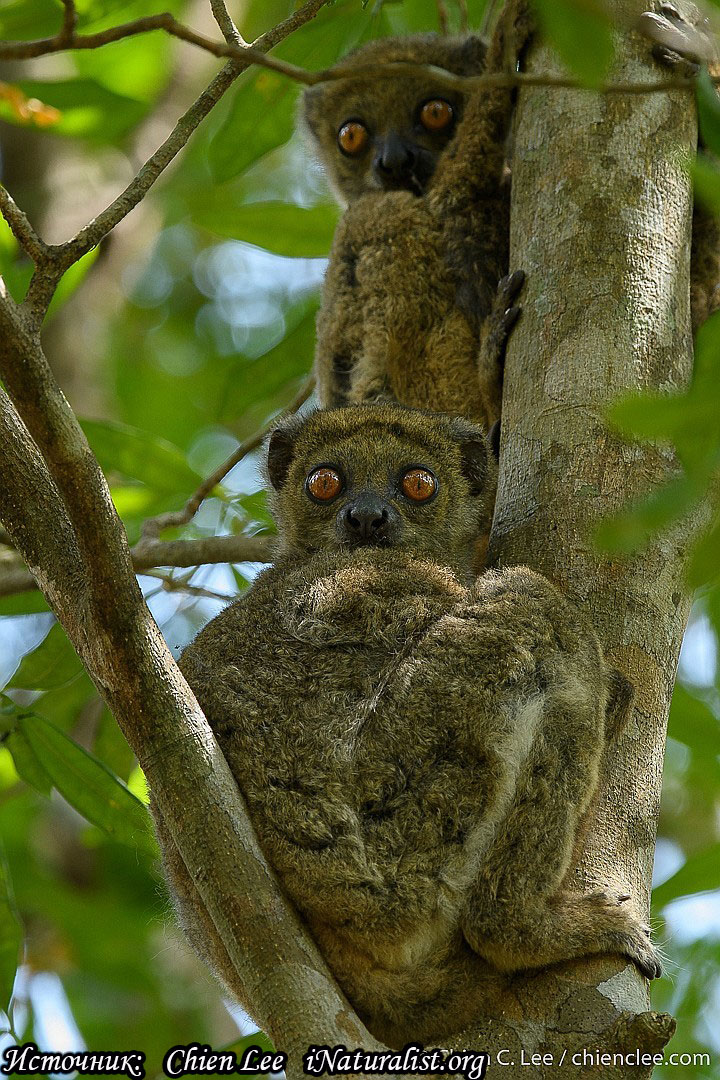

The Bemaraha woolly lemur (Avahi cleesei), also known as Cleese's woolly lemur, is a species of woolly lemur native to western Madagascar, named after John Cleese.
The first scientist to discover the species named it after Cleese, star of Monty Python, mainly because of Cleese's fondness for lemurs, as shown in Operation Lemur With John Cleese and Fierce Creatures, and his efforts at protecting and preserving them. The species was first recorded in 1990 by a team of scientists from Zurich University led by Urs Thalmann, but wasn't formally described as a species until November 11, 2005.
Appearance
Avahi cleesei is a species of lemur, a primate of the family Indriidae.
Like the others, Avahi cleesei has thick, brownish-grey fur, with a long tail, sometimes curled upwards and backwards. Its head is small and rounded, and the hair on its muzzle forms a light-coloured triangle from forehead to nose. These lemurs are distinguished from related species by the black rings around the eyes. The fur is also black around the nose and light grey on the chest and belly.
Distribution and lifestyle
Found in the Cingy de Bemaraha UNESCO World Heritage site in western Madagascar. The range is believed to be declining rapidly.
Nocturnal woody animals. During the day they sleep in tree hollows and dense thickets. Active just after sunset.
Nutrition and reproduction
They form small family groups that defend their territory of about two hectares. Their diet includes leaves, shoots, tree bark and fruit. They prefer to feed in the upper levels of the forest, occasionally descending to the ground.
Monogamous. Breeding season is in the dry season, from August to November. Pregnancy lasts four to five months; a litter usually contains one young. Young remain with their parents for several years.
Population status
The International Union for Conservation of Nature has given the species the status of "endangered" because, although its range covers some 5000 km², it is declining quite rapidly. The main threat to the population is habitat destruction.