














The gray-headed lemur (Eulemur cinereiceps), or gray-headed brown lemur, the white-collared brown lemur or white-collared lemur (Eulemur albocollaris)
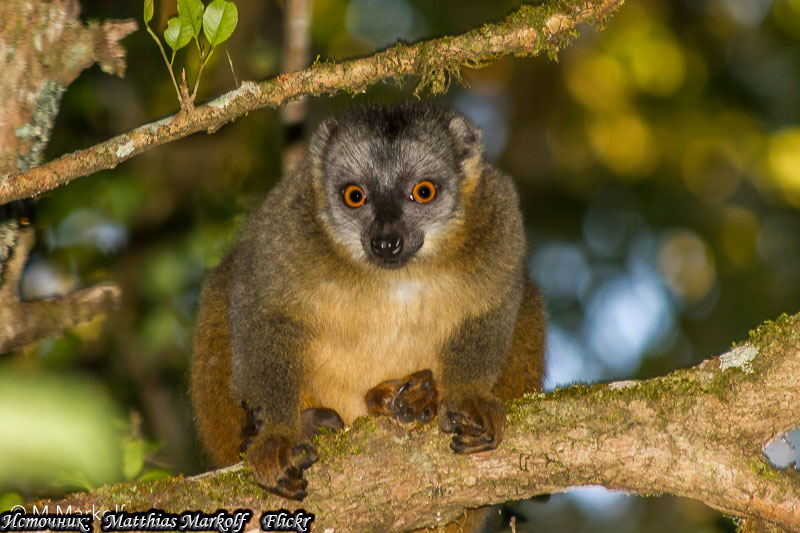

The gray-headed lemur (Eulemur cinereiceps), or gray-headed brown lemur, is a medium-sized primate, a cathemeral species of lemur in the family Lemuridae. Until a taxonomic revision in 2008, it was known as the white-collared brown lemur or white-collared lemur (Eulemur albocollaris).
Description
Formerly considered a subspecies of the brown lemur. In 2001 it was elevated to species status, but some experts still consider it a subspecies based on a combination of genetic and morphological data. Molecular research has also shown that Eulemur albocollaris appears to be a junior synonym of Eulemur cinereiceps.
Lemurs are medium-sized
They move on four limbs, or hop, using their long tail as a counterweight. Externally they resemble members of a related species, Eulemur collaris, but are genetically different. The upper body of males is greyish brown, the limbs and tail are darker. The lower part of the body is light grey. The head is also grey, with a darker crown.
Females have a reddish-brown upper body, a lighter belly and darker limbs than males. The cheeks and chin are covered with long, light wool in males and medium-length reddish wool in females. Body length is 39 to 40.5 cm, tail length 50 to 55 cm and weight 2 to 2.5 kg.
Distribution
Found in southeastern Madagascar, from the Manampatrana River south to the Mananara River.
Behaviour
Forms small groups of four to eleven individuals. Feeds mainly on fruit, supplementing its diet with leaves, flowers and mushrooms.
Population mode
In 2005, analysis of satellite imagery revealed that approximately 700 km2 of the primate's natural habitat remained.
In addition to the destruction of relict forests, illegal hunting poses a threat to the population.
The species is on the list of the 25 most endangered primates.
The International Union for Conservation of Nature has given it a status of "endangered".