














Sanford's brown lemur (Eulemur sanfordi), or Sanford's lemur

Description
Sanford's brown lemur (Eulemur sanfordi), or Sanford's lemur, is a species of strepsirrhine primate in the family Lemuridae. Sanford's brown lemur was previously considered a subspecies of the common brown lemur (Eulemur fulvus) but was raised to full species in 2001. It is named after Leonard Cutler Sanford, a trustee of the American Museum of Natural History.
Previously considered a subspecies of the brown lemur (Eulemur fulvus), but was raised to species status in 2005.
These lemurs are medium-sized. Body length 38 to 40 cm, tail length 50 to 55 cm, total length 88 to 95 cm. Weight 1.8 to 1.9 kg.
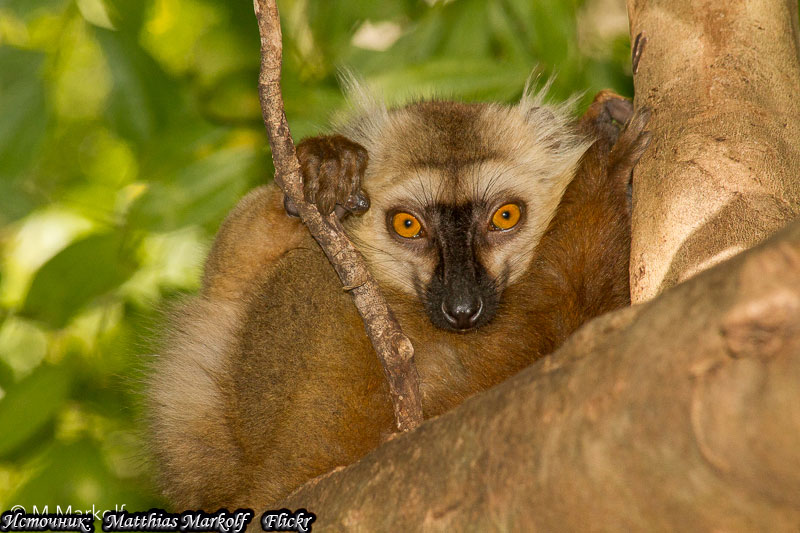
The coat on the upper body of the male is grey to brown; it is darker on the legs, palms and base of the tail. The lower part of the body (belly, thorax and inner surface of the limbs) is light grey or brownish-grey. The tail is dark grey. The muzzle is dark, framed by white or grey fur. They differ from related species by the longer blond hair on the ears and cheeks.
Males have light brown fur on the top of the head. Females have a greyish-brown coat on the upper body, darker on the shoulders, upper half of the back and head. The lower part of the body is light grey, the face also grey, with light markings over the eyes. The tail is usually dark grey.
Distribution
Found in northern Madagascar, from Antsiranana to Ampanakan. The population is concentrated in several forested areas - Ankarana, Analamerana and Ambre - and there is also a small population in the Daraina area. The southern boundary of the range runs along the Manambatu River. Hybrids with the white-fronted lemur (Eulemur albifrons) are found between Vukhemar and Sambava. It inhabits lowland dry and humid tropical rainforests. Also occurs in mid-mountain forests up to 1400 m above sea level.
Behaviour and nutrition
Form groups of 3 to 15 individuals. Each group defends an area of up to 14 hectares. Breeding season in late May; births occur in late September or early October.
Pregnancy lasts approximately 120 days. Usually one offspring in a litter; in captivity, twins are sometimes produced. After birth, the calf clings to its mother's belly and crawls on her back after two weeks. They feed on milk until they are 3 or 4 months old and reach sexual maturity at 2 years.
Their diet consists mainly of fruit; other plant parts (buds, flowers, young leaves) and small invertebrates (spiders, millipedes, insects) supplement it. Poison millipedes are sometimes used as a remedy for external parasites: lemurs irritate millipedes by biting them lightly and rubbing the toxic secretion they release into their fur.
Conservation status
The International Union for Conservation of Nature (IUCN) has given this species the status of "endangered". It is one of the rarest lemur species. Very few are left in the wild, and they are kept in no more than four zoos. The main threats to the population in the wild are habitat destruction due to logging and mining, but hunting for meat is also a serious threat. Lemur meat is considered a delicacy and is sold abroad.