














The golden bamboo lemur (Hapalemur aureus), bokombolomena or varibolomena
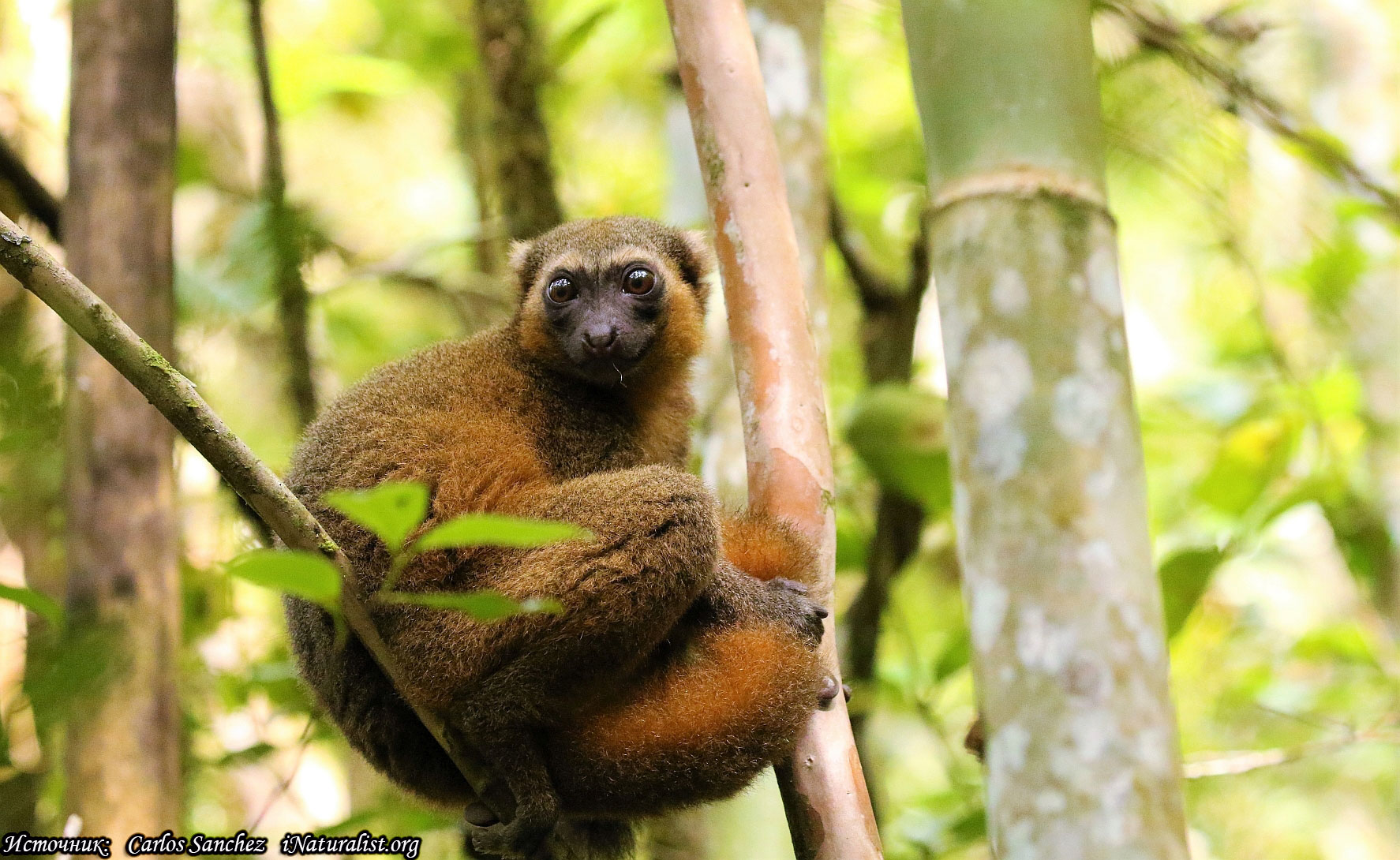

The golden bamboo lemur (Hapalemur aureus), bokombolomena or varibolomena in Malagasy, is a medium-sized bamboo lemur endemic to south-eastern Madagascar.
The golden lemur (Hapalemur aureus) is a species of strepsirrhine primate in the family Lemuridae, discovered in 1987.
It is a mammal of the tame lemur genus (Hapalemur). It is a mammal of the genus of tame lemurs (Hapalemur). They are found only in Madagascar, in the rainforest zone in the southeast of the island. The distribution of these animals is closely related to the growth of bamboo.
Appearance
The total body length of Hapalemur aureus is 80 cm, half of which is the tail. It has a body mass of 1.2-1.6 kg. Its smooth coat is of medium length and its muzzle is short. The head is globular, the ears short and hairy. The face is black, with golden yellow eyebrows, cheeks and throat. Hapalemur aureus shows almost no sexual dimorphism, although females have a more greyish upper body.
Way of life and diet
Hapalemur aureus live in family groups of 2 to 4 animals. The group consists of adult males, adult females and immature individuals. Hapalemures aureus communicate with each other with a high-pitched growl. They lead an arboreal way of life. They are active in the early morning and late afternoon and also at night. They live in areas of about 80 hectares.
Hapalemures aureus are herbivores. They feed mainly on plants of the cereal family and, endemically in Madagascar, on giant bamboos, on whose leaves and shoots they feed. On average, Hapalemures aureus eat up to 500 g of bamboo per day.
Reproduction
During reproduction, Hapalemures aureus live in family groups consisting of one male and one or two females. This means that the mating system is monogamous or polygamous.
Mating takes place from May to September. Pregnancy lasts 135-150 days. Offspring are born in October and February. There may be one or two calves in a litter. Newborn calves weigh about 32g. They are weaned at 20 weeks of age.
No parental behaviour has been recorded in male Hapalemures aureus, i.e. all care of the calves is left to the mother.
Conservation status
A very rare species, with a total of 200-400 individuals of Hapalemur aureus in the wild. Endangered due to habitat destruction, especially by slash-and-burn agriculture and deforestation. Hapalemur aureus is listed in Appendix I of CITES. Hunting of this species is prohibited. The IUCN status is CR (endangered).