














The southern lesser bamboo lemur (Hapalemur meridionalis), the southern bamboo lemur, rusty-gray lesser bamboo lemur, and southern gentle lemur
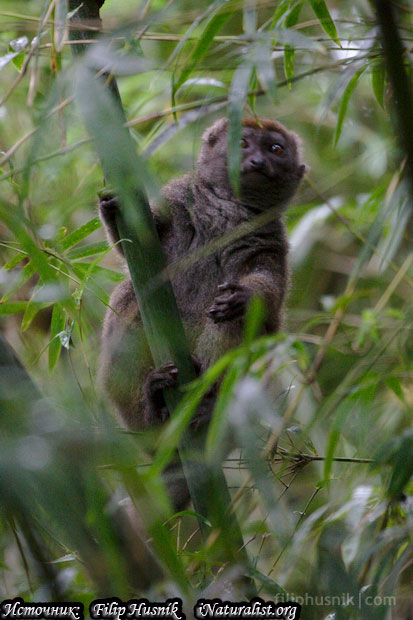

The southern lesser bamboo lemur (Hapalemur meridionalis), also known as the southern bamboo lemur, rusty-gray lesser bamboo lemur, and southern gentle lemur, is a species of bamboo lemur endemic to southern Madagascar.
Taxonomy
It was originally considered to be a subspecies of the eastern lesser bamboo lemur (Hapalemur griseus), and is of similar size, but is darker and redder than the eastern lesser bamboo lemur, with a shorter tail and different vocalizations. The type locality is the forestry station of Mandena, and it is further supported as a separate species by recent mitochondrial DNA research. It is possible that hybridisation with H griseus occurs on the Andringitra Massif at altitudes of 1,600 m (5,200 ft).
Distribution and lifestyle
Hapalemur meridionalis is a species of strepsirrhine primate of the family Lemuridae endemic to southern Madagascar, near Tôlanaro, between the Mananara River in the north and the Andujahuela Nature Reserve. It was initially proposed as a subspecies of the grey bamboo lemur (Hapalemur griseus), as they are similar in size. Day-old animals. Diet is predominantly bamboo.
Description
These animals were formerly considered a subspecies of the tame lemur. However, there are slight external differences, in particular Hapalemur meridionalis has a darker coat with a reddish tinge, the tail is shorter, the vocalisation is also different. The designation as a separate species is supported by mitochondrial DNA tests carried out in 2002.
They are small lemurs and their fur is predominantly red, but has a reddish tinge, especially on the back and head. The tail is longer than the body. The head is lighter in colour than the rest of the body. The ears are quite large, but are completely hidden by the fur. The average body length of males is 67.8 cm and of females 66.78 cm. The average weight of males is 0.839 kg and that of females 0.870 kg.
Conservation status
The International Union for Conservation of Nature has given this species a conservation status of "vulnerable".