














The northern sportive lemur (Lepilemur septentrionalis)
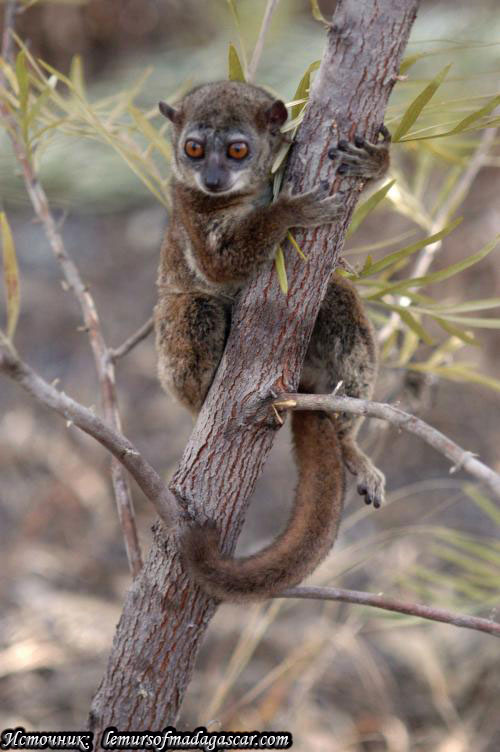

The northern sportive lemur (Lepilemur septentrionalis), also known as the Sahafary sportive lemur or northern weasel lemur, is a species of lemur in the family Lepilemuridae. It is endemic to Madagascar.
Description
Lepilemur septentrionalis is a species of primate mammal in the family Lepilemuridae. Lepilemur septentrionalis is one of the smallest members of the genus Lepilemuridae. Its body length averages 28 cm and its tail length 25 cm. Its weight is 0.7 to 0.8 kg. Its coat is greyish-brown, while the upper part is dark brown. A dark greyish stripe runs along the back of the head. The underside of the body is grey. The pads of the toes are broad and fleshy, which improves the grip on tree branches. Large eyes, adapted to a nocturnal lifestyle. The cecum is enlarged, suggesting a plant-based diet. Ears are smaller than those of other members of the genus.
Taxonomy
The genus Lepilemur was initially thought to comprise only 2 species: Lepilemur mustelinus and Lepilemur ruficaudatus, with the latter subdivided into 2 subspecies. The genus was later reclassified as having only 1 species, mustelinus, with 5 subspecies. In 1977, Petter et al. increased the species number of the genus to 7, at which point the species Lepilemur septentrionalis was demarcated, and classified as having 4 subspecies. As 2 of these subspecies were not geographically distinct, the number of Lepilemur septentrionalis subspecies was eventually condensed to 2: Lepilemur septentrionalis septentrionalis and Lepilemur septentrionalis ankaranensis. As a result of subsequent cytogenetic and molecular analyses, the 7 species of Lepilemur were confirmed by Rumpler et al., but the Lepilemur septentrionalis ankarensis subspecies was elevated to the status of full species, resulting in 8 species of lemur classified within the genus. A further three molecular genetic studies have led to the inclusion of another 15 species of Lepilemur, making it the most diverse lemur genus at 23 species. In 2004, a study of the evolutionary relationships of various subpopulations of the northern sportive lemur was carried out, in which sequence analyses of the mitochondrial DNA of a large number of Lepilemur septentrionalis individuals from the different subpopulations were performed. A significant number of fixed differences present in the lemurs in the Sahafary region distinguished them from the lemurs in other regions, suggesting that the northern sportive lemur in fact exists as two separate cryptic species, most likely caused by chromosomal rearrangements in one of the Lepilemur septentrionalis evolutionary lineages.
Distribution
Lepilemur septentrionalis is found in the far north of Madagascar, north of the Irudu River, in small patches of forest near the villages of Madirube and Ankarungana in Sahafari, and also around Andrahuna, a small mountain formation 30 km from Antsiranana. They are found at altitudes not exceeding 300 metres.
Life and reproduction
Lepilemur septentrionalis are nocturnal arboreal animals. During the day, they sleep in hollows or pockets in tree branches at a height of 1 to 8 metres above the ground. Lepilemur septentrionalis moves mainly by leaping. Its diet consists mainly of leaves, as well as flowers and fruits.
Males lead a solitary territorial life, their territory overlapping with that of one or more females, with whom they mate during the mating season.
Pregnancy lasts 120-150 days and there is usually one offspring per litter. The breeding season runs from September to December. Males do not participate in the rearing of young. The young are milk-fed until they are four months old, but are dependent on their mother until they are one year old. Puberty occurs around 18 months of age.
Lepilemur septentrionalis on the Red List
The International Union for Conservation of Nature has classified the species as "threatened". The population of Lepilemur septentrionalis in the wild is estimated at several hundred individuals. The range is highly fragmented, with no more than 50 individuals in each fragment.
The main threats to the species are hunting and habitat destruction. The species is listed as one of the "25 most vulnerable primates".