














The red giant flying squirrel or common giant flying squirrel (Petaurista petaurista)
Systematics, class, species, genus, family, order
The red giant flying squirrel or common giant flying squirrel (Petaurista petaurista) is a species of rodent in the family Sciuridae (squirrels).
The red giant flying squirrel or common giant flying squirrel (Petaurista petaurista): class - Mammalia, order - Rodentia, family - Sciuridae, genus - Petaurista petaurista.
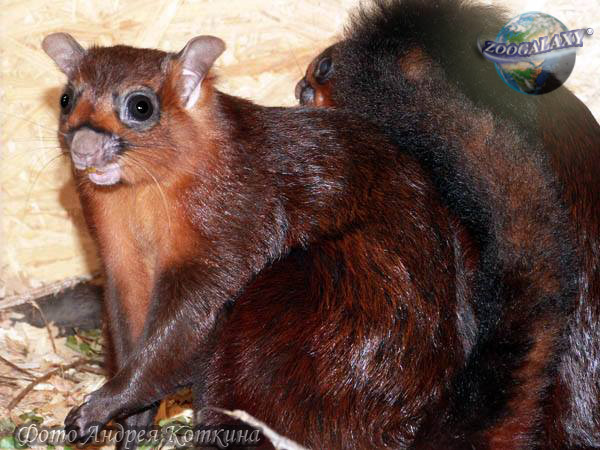
The fur is dark red with black "stockings" on the legs. The body length is 42 cm. The tail is long and serves as a stabiliser when flying between trees. It is a nocturnal animal and feeds mainly on leaves, fruits and nuts, and occasionally on insects. This species faces no specific threats other than continued habitat destruction. It is widespread and fairly abundant, which is why it is listed as a "Least Threatened Species" on the IUCN Red List.
In the wild, Petaurista petaurista feeds primarily on cones, leaves and branches, also fruit and nuts, and occasionally insects. It is capable of aerial planning over long distances. There have been reports of flights up to 75 metres and beyond; it plans generally at an angle of 40-60 degrees from the horizontal, sometimes at a steeper angle for shorter flights. Petaurista petaurista settle in hollow trees at least 10 metres above the ground. Petaurista petaurista is nocturnal and does not hibernate in winter, but migrates to areas with plenty of food. Petaurista petaurista may settle in conifer plantations. It is most active between dusk and midnight, and the size of individual adult male plots in conifer plantations is estimated at 3.2 ha
Taxonomy
It varies considerably in appearance depending on subspecies and location. Roughly, it can be divided into the following subspecies groups, some of which variously have been regarded as part of this species, the Indian giant flying squirrel (Petaurista philippensis), the red and white giant flying squirrel (Petaurista alborufus) or the spotted giant flying squirrel (Petaurista elegans), or their own separate species. Up until the 1980s, some authorities even listed the Indian giant flying squirrel itself as a subspecies of the red giant flying squirrel.
Behavior
The red giant flying squirrel is largely nocturnal, starting its activity just before dusk and retreating at dawn. On occasion it may stay out until the mid-morning. The day is typically spent in a hole in a tree that is 10 m (33 ft) or more above the ground, although sometimes in rock crevices or a nest made of vegetation in a tree instead. In a study of seven nests in India's Namdapha National Park, one tree hole was c. 35 m (115 ft) above the ground, while the remaining were between about 15 and 21 m (49–69 ft) above the ground. Red giant flying squirrels and hornbills sometimes compete for the same tree holes.
Gliding
The red giant flying squirrel usually travels between trees by long glides, up to at least 100–150 m (330–490 ft), reputedly even 450 m (1,480 ft). Most glides are no longer than 50 m (160 ft). Glides are most often launched from the upper tree canopy, less often the mid or lower canopy. The animal lands well below its launch height, as the typical glide angle is about 14–22°. Nevertheless, landing heights generally are more than 3 m (10 ft) above the ground and typically much higher. As long as the separation between remaining tall trees does not exceed its typical glide distance, this species survives well in degraded habitats, even willingly crossing highways. However, if distances between trees exceed the typical glide distance, it forms an efficient barrier for the species.
Feeding
The red giant flying squirrel is a herbivore, primarily a folivore, and has been recorded feeding on the leaves of many plant species. Young leaves are preferred over older leaves. Other items recorded in its diet are shoots, flowers, fruits, nuts, seeds, lichen, moss, twigs, bark and in the northern part of its range pine cones. In Taiwan alone, Petaurista petaurista grandis has been recorded feeding on at least 30 species of plants from 19 families. When feeding extensively on bark it may kill trees in the process and for this reason it is sometimes considered a pest in conifer plantations, while its frugivory can result in conflicts with humans in fruit plantations. Although not fully confirmed, there are strong indications that flower-feeding red giant flying squirrels may function as pollinators of certain trees. Some populations, at least Petaurista petaurista yunanensis, will visit specific locations to feed on minerals directly from cliffs/earth.
When only relatively poor food sources like older leaves are available, the red giant flying squirrel is still active, but less so compared to periods where richer food sources like young leaves and fruits are available. The populations that live in colder mountainous regions (for example, Petaurista petaurista albiventer) remain active even when there is deep snow on the ground, but during this time may move to lower altitudes.
While some species of giant flying squirrels will supplement their diet with small animals, primarily insects, this has not been reported in the red giant flying squirrel.
Social life and breeding
Densities vary greatly in the red giant flying squirrel. In Taiwan (Petaurista petaurista grandis), it varies from an average of around five animals per 20 ha (50 acres) in hardwood forests to around one-fifth that density in conifer plantations, although there are also reports of home ranges in the latter habitat that are as small as, or even a bit smaller, than the average reported in the former habitat. It is often the most common species of giant flying squirrel in the Sundaic region.
It has an oft-uttered call that especially is given at dusk, and in Himalaya (Petaurista petaurista albiventer) has been described as a "monotonous repeated wail" or a "loud, penetrating and drawn-out whine". Sometimes small groups may actively call out to each other over a longer period. Otherwise the species typically occurs alone, or in pairs. The mother or pair are sometimes accompanied by a young, as they forage together for a few to several months after birth.
There is usually only one, infrequently two, young in a litter, as typical of giant flying squirrels. In Taiwan (Petaurista petaurista grandis), there are two breeding seasons per year, with most births in January–February and July–August. In Uttarakhand of India, a young was found in a nest in May and in Malaysia pregnant females have been recorded in February. The young suckle for an extended period of time after being born; more than two months in Petaurista petaurista albiventer.