














The Ethiopian wolf, the red jackal, the Simien jackal or Simien fox (Canis simensis)
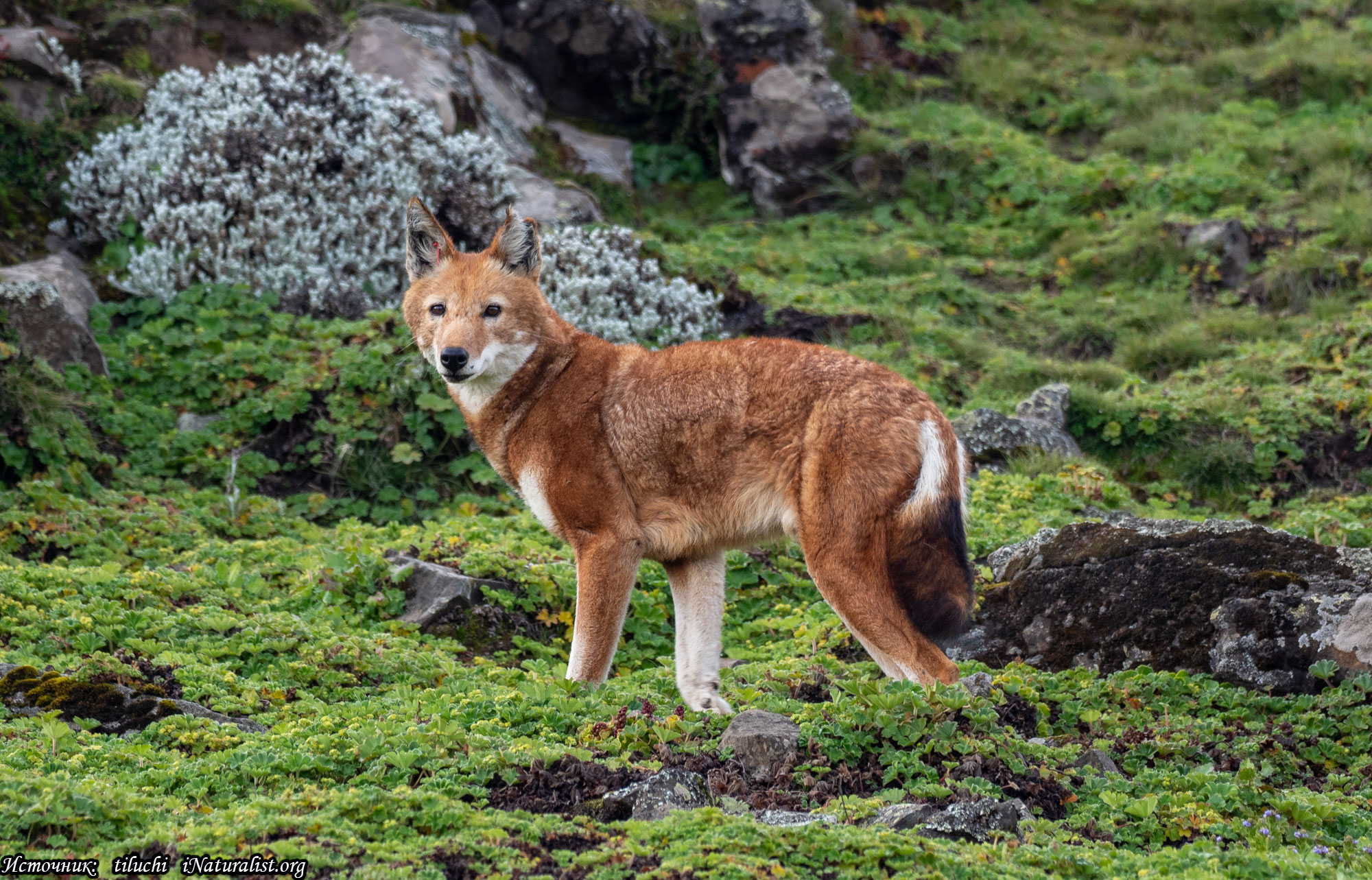

The Ethiopian wolf (Canis simensis), also called the red jackal, the Simien jackal or Simien fox, is a canine native to the Ethiopian Highlands. In southeastern Ethiopia it is also known as the horse jackal. It is similar to the coyote in size and build, and is distinguished by its long and narrow skull, and its red and white fur. Unlike most large canids, which are widespread, generalist feeders, the Ethiopian wolf is a highly specialised feeder of Afroalpine rodents with very specific habitat requirements. It is one of the world's rarest canids, and Africa's most endangered carnivore.
The species's current range is limited to seven isolated mountain ranges at altitudes of 3,000–4,500 m, with the overall adult population estimated at 360–440 individuals in 2011, more than half of them in the Bale Mountains.
The Ethiopian wolf is listed as endangered by the IUCN, on account of its small numbers and fragmented range. Threats include increasing pressure from expanding human populations, resulting in habitat degradation through overgrazing, and disease transference and interbreeding from free-ranging dogs. Its conservation is headed by Oxford University's Ethiopian Wolf Conservation Programme, which seeks to protect wolves through vaccination and community outreach programs.
Naming
Alternative English names for the Ethiopian wolf include the red jackal, the Simenian fox, the Simien jackal, Ethiopian jackal, and Abyssinian wolf.
Appearance
Canis simensis is a long-legged, long-nosed wolf; its appearance is more or less typical of the canid family; it is dark reddish in colour, with a light (often white) throat, chest and lower part of the limbs, and some individuals have light patches on other parts of the body; the back of the ears and the upper part of the tail are black. Males weigh an average of 16 kg and females 13 kg. Shoulder height is about 60 cm.
Distribution and lifestyle
The range of Canis simensis is divided into seven distinct populations: five north of the Ethiopian rift and the two largest in the south (all of Ethiopia). There is a set of minor but persistent differences between wolves on different sides of the Rift Valley. Thus, the mountain range is divided into two almost isolated parts during part of the Pleistocene.
Canis simensis is ecologically very specialised: it lives only in treeless areas above 3,000 m altitude, in alpine meadows; below this altitude, in the hot climate of this part of Africa, these animals cannot live.
This species is territorial and monogamous. Young animals usually remain in their breeding sites, forming flocks of 2 to 8 animals. Females leave the area where they were born before the males, so there is a numerical superiority of males over females.
Nutrition
About 95% of the diet of these raptors consists of rodents. They feed on giant African blindfeet, which can weigh between 300 and 900 grams, and other bathyergids, as well as smaller rats and various mice. Occasionally, Canis simensis catch hares, small antelopes or antelope calves of larger species, such as the mountain nyala. They hunt their prey in open ground, creeping stealthily until they are within striking distance (5-20 m). They may also dig their prey in holes in the ground, or occasionally scavenge carrion. Instances of livestock hunting are extremely rare.
The Oromo of southern Ethiopia call this beast the "horse jackal", because of its habit of accompanying pregnant mares and cows to eat the discarded placenta after birth.
Canis simensis is a diurnal predator, which is quite unusual for predators of this genus.
Reproduction
Mating occurs seasonally, in August-September, and offspring are born two months later. The offspring have two to six cubs, which are fed by all members of the herd. Only the alpha pair (the leader and his female) usually breed in the herd. Young males begin to roam with the herd at six months of age, but do not become fully mature until they are two years old.
Conservation status
Of the seven populations, only one, in the Bale Mountains, has more than 100 individuals; the total number of the species is approximately 600 adults. The most powerful factors threatening the species' existence are its very narrow range (only cold-climate alpine meadows, which are shrinking due to global warming), the occupation of suitable hunting areas by agriculture and the diseases wolves contract from domestic dogs: for example, in 1990 a rabies epidemic reduced the largest population (in the Bale Mountains National Park) from 440 to less than 160 individuals in less than a week. Interestingly, this park was established in 1970 precisely to protect Canis simensis and the mountain nyala. Although Canis simensis is called the Symen fox, its population in the Symen Mountains is negligible.
Canis simensis is listed in the Red Data Book as endangered; in 2003 there were no animals in captivity.
The Oromo people, on whose land Canis simensis mainly lives, are not particularly hostile to it, provided, of course, that the animal does not disturb their herds. As for other ethnic groups, they occasionally hunt Canis simensis, as they attribute medicinal properties to its liver.
Admixture with other Canis species
In 2018, whole genome sequencing was used to compare members of the genus Canis. The study supports the African golden wolf being distinct from the golden jackal, and with the Ethiopian wolf being genetically basal to both. There are two genetically distinct African golden wolf populations that exist in northwestern and eastern Africa. This suggests that Ethiopian wolves – or a close and extinct relative – once had a much larger range within Africa to admix with other canids. There is evidence of gene flow between the eastern population and the Ethiopian wolf, which has led to the eastern population being distinct from the northwestern population. The common ancestor of both African golden wolf populations was a genetically admixed canid of 72% grey wolf and 28% Ethiopian wolf ancestry.
Subspecies
As of 2005, two subspecies are recognised by Mammal Species of the World Volume Three (MSW3).
Northern Ethiopian wolf, Canis simensis Simensis (Nominate subspecies) - Northwest Rift Valley: Simien Mountains, Mount Guna, Guassa Menz, north and south Wollo highlands. Synonyms: C. s. Crinensis (Erlanger & Neumann, 1900), C. s. Semiensis (Heuglin, 1862), C. s. Simensis (Gray, 1869), C. s. Walgi (Heuglin, 1862).
Southern Ethiopian wolf, Canis simensis Citernii - This canid was initially classed as a distinct subspecies on account of its bright red coat, though this characteristic is unreliable as a taxonomic distinction. However, its nasal bones are consistently longer than those of the nominate subspecies. Southeast Rift Valley: Arsi and Bale Mountains.
Hunting behaviours
Unlike most social carnivores, the Ethiopian wolf tends to forage and feed on small prey alone. It is most active during the day, the time when rodents are themselves most active, though they have been observed to hunt in groups when targeting mountain nyala calves. Major Percy-Cotton described the hunting behaviour of Ethiopian wolves as thus:
... they are most amusing to watch, when hunting. The rats, which are brown, with short tails, live in big colonies and dart from burrow to burrow, while the cuberow stands motionless till one of them shows, when he makes a pounce for it. If he is unsuccessful, he seems to lose his temper, and starts digging violently; but this is only lost labour, as the ground is honeycombed with holes, and every rat is yards away before he has thrown up a pawful.
The technique described above is commonly used in hunting big-headed African mole-rats, with the level of effort varying from scratching lightly at the hole to totally destroying a set of burrows, leaving metre-high earth mounds.
Wolves in Bale have been observed to forage among cattle herds, a tactic thought to aid in ambushing rodents out of their holes by using the cattle to hide their presence. Ethiopian wolves have also been observed forming temporary associations with troops of grazing geladas. Solitary wolves hunt for rodents in the midst of the monkeys, ignoring juvenile monkeys, though these are similar in size to some of their prey. The monkeys, in turn, tolerate and largely ignore the wolves, although they take flight if they observe feral dogs, which sometimes prey on them. Within the troops, the wolves enjoy much higher success in capturing rodents than usual, perhaps because the monkeys' activities flush out the rodents, or because the presence of numerous larger animals makes it harder for rodents to spot a threat.
Threats
The Ethiopian wolf has been considered rare since it was first recorded scientifically. The species likely has always been confined to Afroalpine habitats, so it was never widespread. In historical times, all of the Ethiopian wolf's threats are both directly and indirectly human-induced, as the wolf's highland habitat, with its high annual rainfall and rich fertile soils, is ideal for agricultural activities. Its proximate threats include habitat loss and fragmentation (subsistence agriculture, overgrazing, road construction, and livestock farming), diseases (primarily rabies and canine distemper), conflict with humans (poisoning, persecution, and road kills), and hybridisation with dogs.
Disease
Rabies outbreaks, stemming from infected dogs, have killed many Ethiopian wolves over the 1990s and 2000s. Two well-documented outbreaks in Bale, one in 1991 and another in 2008–2009, resulted in the die-off or disappearance of 75% of known animals. Both incidents prompted reactive vaccinations in 2003 and 2008–2009, respectively. Canine distemper is not necessarily fatal to wolves, though a recent increase in infection has occurred, with outbreaks of canine distemper having been detected in 2005–2006 in Bale and in 2010 across subpopulations.