














The African clawless otter, the Cape clawless otter or groot otter (Aonyx capensis)
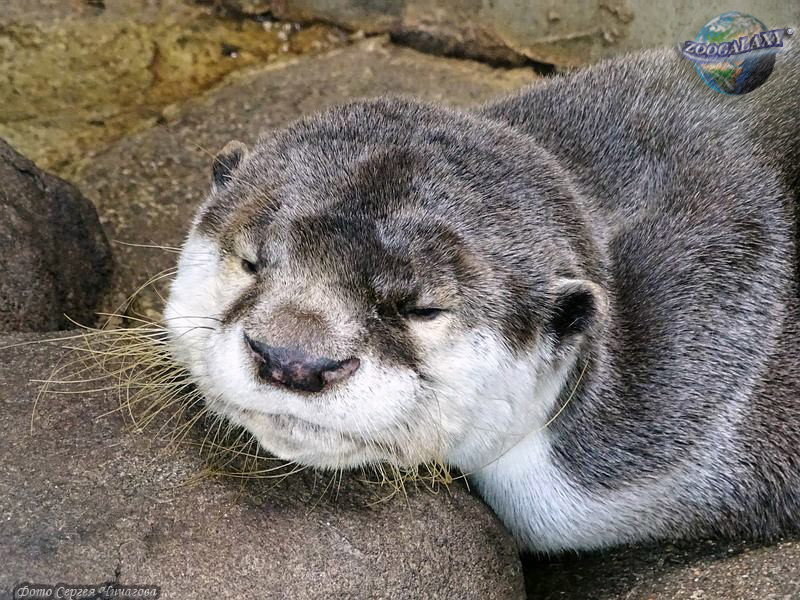
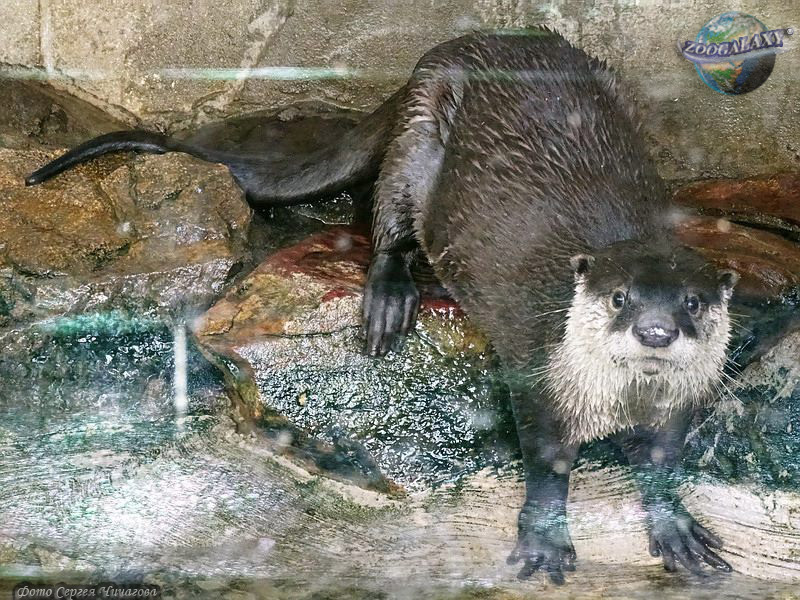
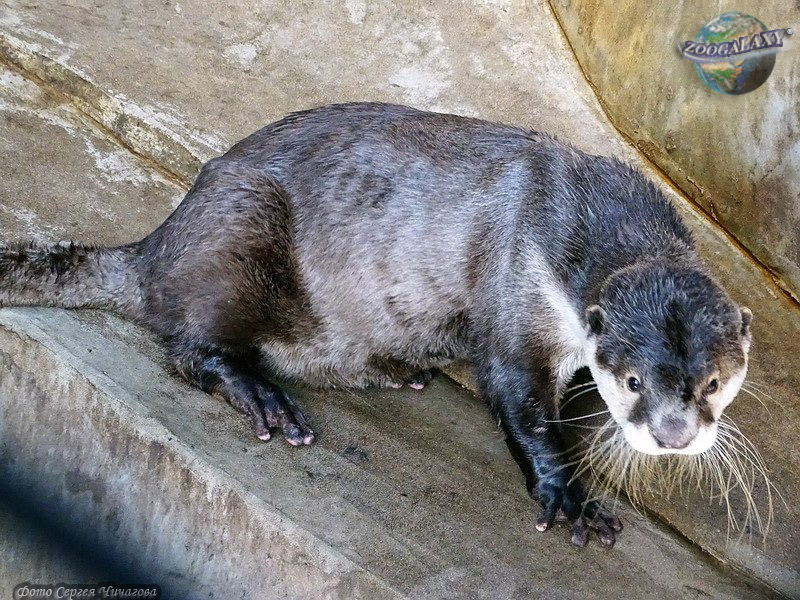
The African clawless otter (Aonyx capensis), also known as the Cape clawless otter or groot otter, is the second-largest freshwater otter species. It inhabits permanent water bodies in savannah and lowland forest areas through most of sub-Saharan Africa. It is characterised by partly webbed and clawless feet, from which their name is derived. The word 'aonyx' means clawless, derived from the prefix a- ("without") and onyx ("claw/hoof").
Taxonomy
Aonyx capensis is a member of the weasel family (Mustelidae) and of the order Carnivora. The earliest known species of otter, Potamotherium valetoni, occurred in the upper Oligocene of Europe: A. capensis first appears in the fossil record during the Pleistocene. Aonyx is closely related to the extinct giant Sardinian otter, Megalenhydris.
Subspecies
Mammal Species of the World lists six subspecies of the African clawless otter:
- Aonyx capensis capensis (Schinz, 1821);
- Aonyx capensis hindei (Thomas, 1905);
- Aonyx capensis meneleki (Thomas, 1903);
- Aonyx capensis microdon (Pohle, 1920);
- Aonyx capensis philippsi (Hinton, 1921).
Until recently the Congo clawless otter was considered a subspecies as well, but recent authorities treat it as a separate species A. congicus.
Description and distribution
Aonyx capensis is a species of carnivorous mammal in the family Mustelidae.
Aonyx capensis is common in ponds, slow-flowing streams, coastal waters and estuaries in South Africa, Ethiopia and Senegal. These otters can be found everywhere from open coastal plains and semi-desert areas to densely forested regions. Aonyx capensis reaches a body length of 95-100 cm, the tail is 55 cm long and weight ranges from 10-30 kg (but 12-20 kg is most common). The webbing between the toes of Aonyx capensis is small, but they swim and dive well. Their claws are small and only grow on the second and third toes of the hind legs. Its fur is not as dense as that of most otters and is therefore not actively hunted.
Nutrition
The basis of the diet of Aonyx capensis is crabs. They easily open their hard shells with their large, flat molars. It also feeds on other aquatic and semi-aquatic animals: molluscs, worms, fish, frogs, birds and small mammals.
Aonyx capensis dive for prey and search for them on the bottom, digging in the mud and picking up stones and twigs. Their extremely sensitive whiskers (vibrissae) are used as sensors in the water to track possible prey. Like other otter species, they often come ashore with their prey and eat it by holding it with their forelegs.
Lifestyle
Aonyx capensis have a mostly crepuscular and nocturnal lifestyle, especially in urban areas. They do not burrow, but live in family groups of up to 5-6 individuals, in pairs or individually in crevices and under stones. Each group has its own territory.
Reproduction
Aonyx capensis mate during the rainy season in December, after which males and females return to solitary life. Pregnancy lasts about two months and in early spring 2-5 young are born. Only the female takes care of them and feeds them with milk until they are 45-60 days old. The young reach sexual maturity at around one year of age and remain with the female until at least that time.
Predation
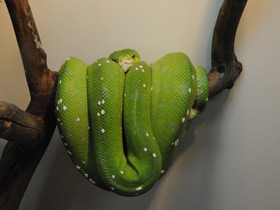
Quick in the water and burrowing on land, the African clawless otter does not have many predators. Its greatest threat comes from the python, which will often lie in wait near or in the water. Other predators would include the crocodile and African fish eagle. If threatened, a high-pitched scream is emitted to warn neighboring otters and confuse a predator.
Thermoregulation
Living in Africa, environments can become very hot. Staying cool means spending time in the water, and using burrows as a way to escape the highest temperatures of the day. To stay warm, on the other hand, the otters depend solely on their thick fur. Guard hairs cover the body, acting as insulation. Since the otter lacks an insulating layer of body fat, its only means of warmth is provided by its thick coat of fur.
Threats
The biggest threat to African clawless otters comes from humans. Aonyx specimens will often forage in man-made fisheries and may be hunted or become entangled in nets. Overfishing by humans may reduce the food supply available to otters. They are sometimes hunted for their thick, soft pelts, which humans use in forms of clothing. In forested areas, logging may be a major threat, since erosion leads to greatly increased turbidity in rivers which can in turn greatly reduce the populations of fish on which the otters depend. This may well be a far greater threat to otters than hunting. The Otter Trail is a hiking trail in South Africa named after the African clawless otter, which is found in this area. Otters along the trail are protected, as it falls within the Tsitsikamma National Park.