














The steppe polecat, the white or masked polecat (Mustela eversmanii)
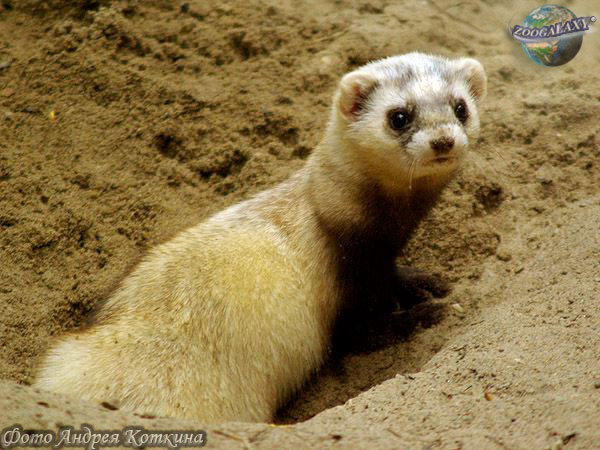
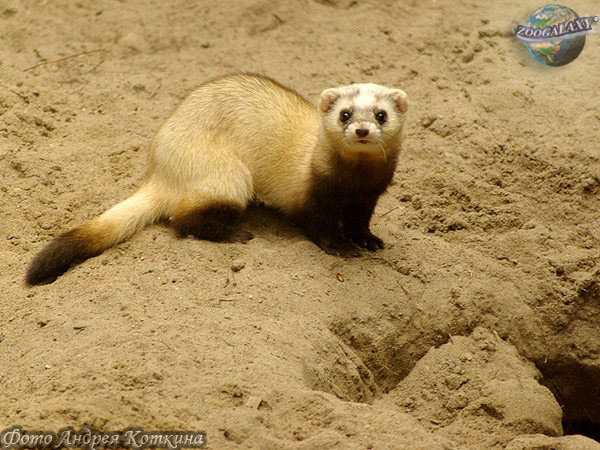
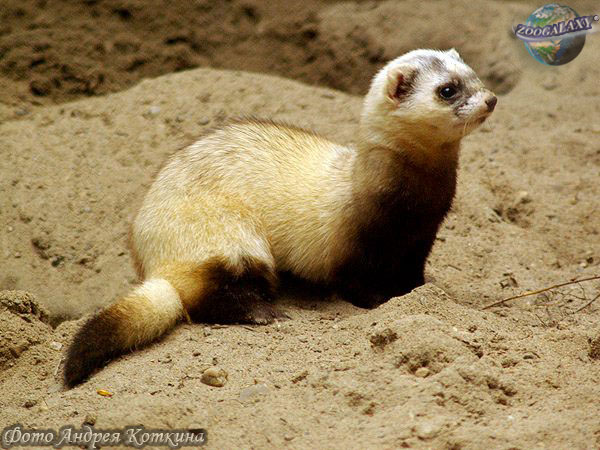
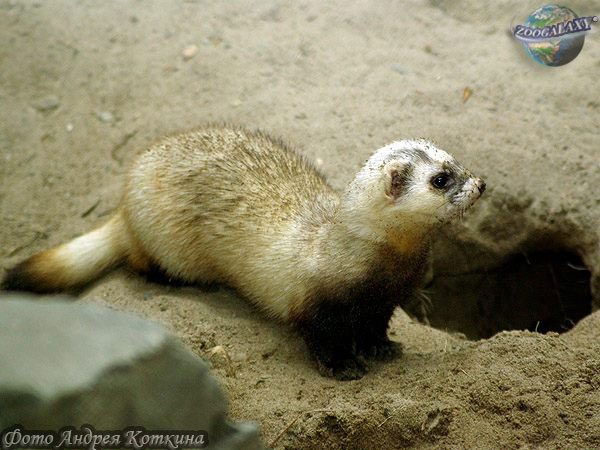
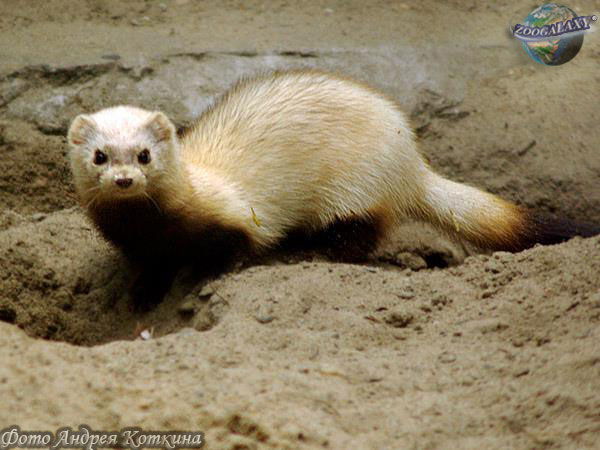

The steppe polecat (Mustela eversmanii), also known as the white or masked polecat, is a species of mustelid native to Central and Eastern Europe and Central Asia. It is listed as Least Concern on the IUCN Red List because of its wide distribution, occurrence in a number of protected areas, and tolerance to some degree of habitat modification
Description
Mustela eversmanii or Mustela eversmanni is a carnivorous mammal of the family Mustelidae, and one of several species of polecat in the genus Mustela.
Mustela eversmannii is the largest of the ferrets, with a body length of 52-56 cm, a tail of up to 18 cm and a weight of 2 kg. It has a high but sparse coat, so that the thick light undercoat is clearly visible through the fur. It has dark-coloured feet and tail, as well as a mask-like face. Mustela eversmannii is a fast jumper and can swim.
Habitat
In the west, Mustela eversmannii is found from Yugoslavia and the Czech Republic, and further east in the forest steppes, steppes and semi-deserts of Russia, from Transbaikalia to the Middle Amur, and also in Middle and Central Asia to the Far East and eastern China. The kinship between the Eurasian ferret species is so great that they interbreed freely, so that animals similar to Mustela nigripes and Mustela eversmannii are frequently found in jointly inhabited areas.
The habitat of Mustela eversmannii is plains and mountain steppes (heaths, gentle slopes, grasslands) and the forest-steppe zone (clearings, flood meadows). It avoids dense forests and human settlements. In Europe, it occurs at altitudes up to 800 m, while in Central Asia it ascends to alpine meadows (up to 3000 m).
Lifestyle
Mustela eversmannii is nocturnal and crepuscular, sometimes active during the day. It makes permanent nests in dry uplands, occupying the burrows of other rodents (marmots, moles, hamsters), having enlarged and slightly arranged them. It digs its own burrows only in case of acute need, and uses them as temporary dwellings. In the fields, it settles in thickets of tall grass, near rocks, in ruins, among roots and in tree hollows.
On the ground, Mustela eversmannii jumps (up to 50-70 cm), while it can hardly climb trees, but jumps easily from great heights. It swims well and can dive. In times of danger, Mustela eversmannii defends itself by shooting a foul-smelling, acrid secretion from its anal glands at the enemy.
Reproduction
Outside the breeding season, Mustela eversmannii lead a solitary lifestyle. The boundaries of individual patches of Mustela eversmannii are virtually unguarded. There is usually no aggression when single-sex individuals are encountered. During the mating season in late winter, males fight each other over females, shouting and biting.
Females build a nest in piles of hay or tree hollows (of grass and other soft materials) and cover it with feathers, down and dry grass. The male takes part in the rearing of the young.
If the first litter dies, the female goes into oestrus within 6-26 days. Pregnancy in Mustela eversmannii lasts about 1.5 months.
The female gives birth to 4-10 naked pups. Their eyes open on the 28th-39th day. Until the young grow hair, the female rarely leaves them. She feeds them with milk until they are two and a half months old.
At 7-8 weeks of age, the pups are already trying to forage for rodents on their own. The female actively protects the young. The offspring stay together for up to 2.5 months, and in late summer the young ferrets disperse in search of their territory.
They reach sexual maturity at 10-12 months of age.
Nutrition
Like all other representatives of the family, Mustela eversmannii is a predator, feeding mainly on rodents (gophers, hamsters, mice), pikes, less frequently on birds, snakes and frogs, and in summer on various invertebrates. All Mustela eversmannii make hordes in case of excessive prey. In some cases Mustela eversmannii are known to cause damage to poultry production, but outside populated areas they are certainly useful, as they exterminate small and medium-sized rodents.
Subespecies
- Mustela eversmanii amurensis;
- Mustela eversmanii eversmanii;
- Mustela eversmanii hungarica;
- Mustela eversmanii larvatus;
- Mustela eversmanii michnoi;
- Mustela eversmanii talassicus.
Diseases and parasites
The steppe polecat is weakly susceptible to sylvatic plague, tularemia and canine distemper. Weakened individuals are susceptible to pasteurellosis. Helminth infections, as well as tick infestations are widespread in the species. Up to 11 flea species are known to infest the steppe polecat, some of which are picked up from its prey.
Relationships with humans
The steppe polecat is of great economic value to nations of the former Soviet Union. It kills large numbers of rodents harmful to agriculture and which spread disease; a single steppe polecat can destroy at least 200 ground squirrels a year or 1,500 mouse-like rodents in winter alone. It is also very important to the fur trade of the former Soviet Union. It holds first place among harvested furbearers in Kazakhstan and other regions. However, steppe polecat numbers dropped noticeably during 1926–1929 and 1956–1959. This decline was attributed to changes in steppe landscapes and a decrease in the species' natural prey in connection with the application of chemical methods in controlling rodent populations, the plowing of Virgin Lands and changes in agrochemical methods. The steppe polecat is fairly easy to harvest. It is primarily caught with jaw traps located near inhabited burrows.