














The giant otter or giant river otter (Pteronura brasiliensis)
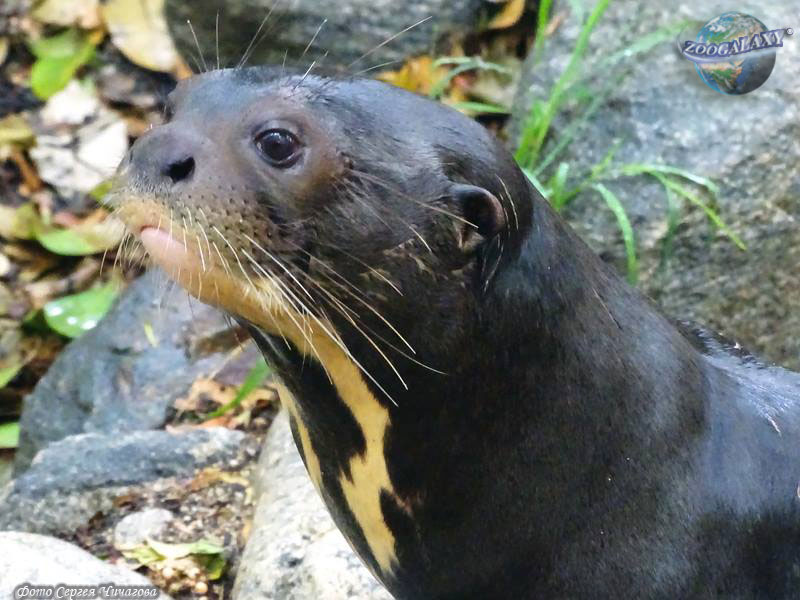
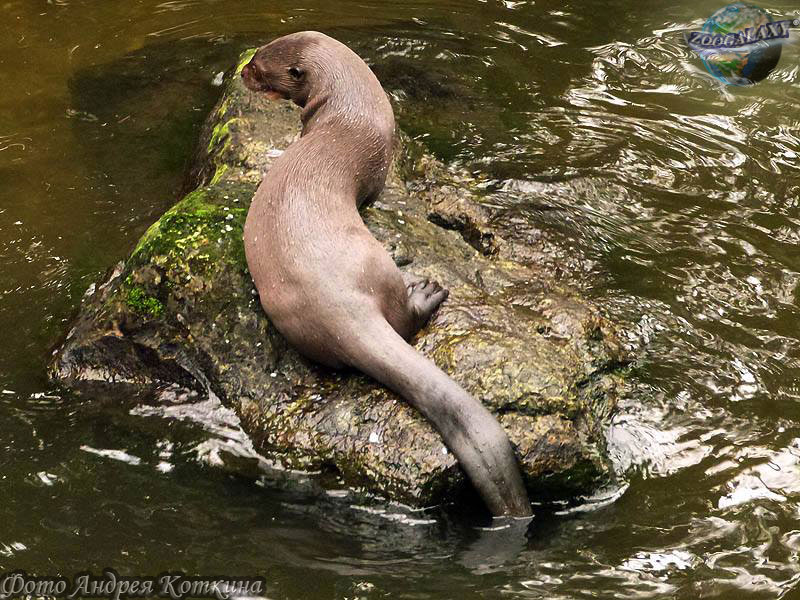
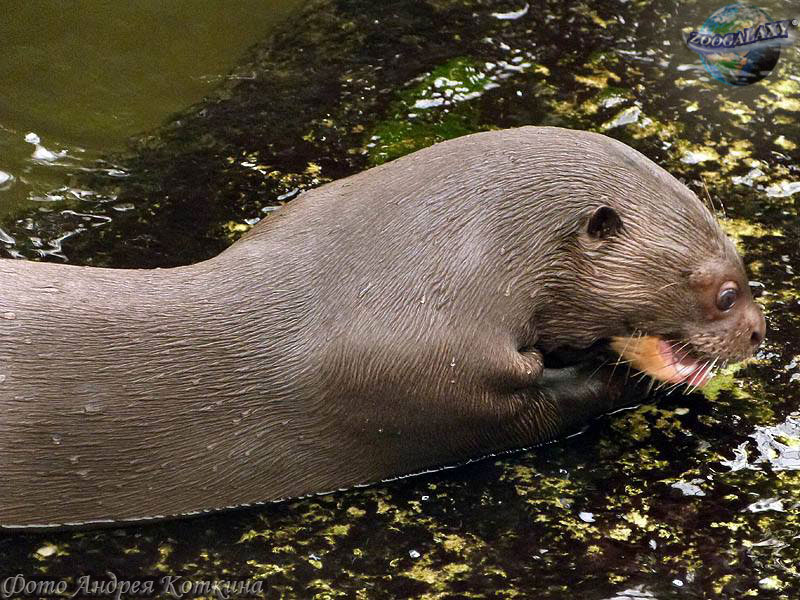
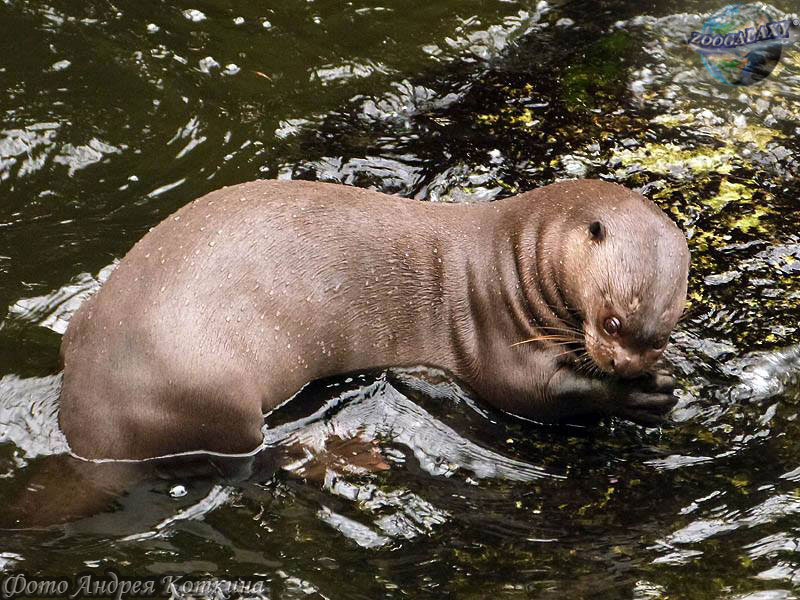
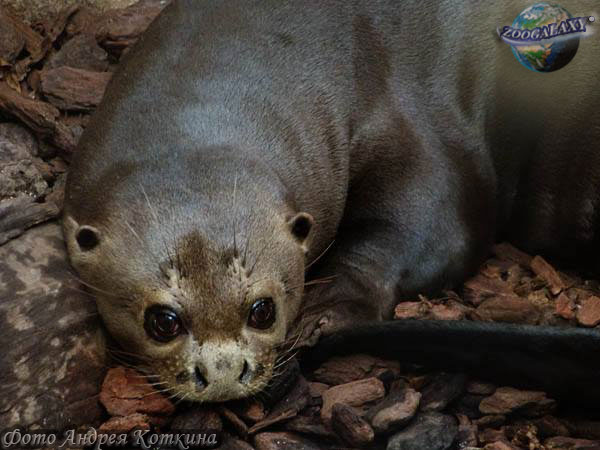
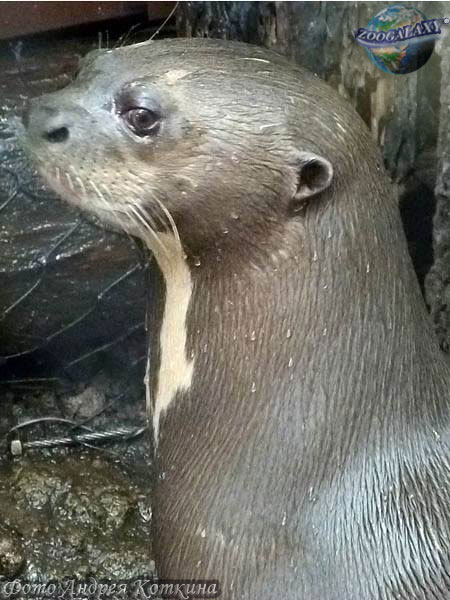

The giant otter or giant river otter (Pteronura brasiliensis) is a South American carnivorous mammal.
Description and habitat area
Pteronura brasiliensis is a species of carnivorous mammal in the family Mustelidae.
Pteronura brasiliensis is the largest member of the pteranid family. It is 1.8 m long and with its tail can reach almost 2.7 m, and weighs between 22 and 26 kg. A sea otter may weigh more, but it is not as long as a giant otter. The species is found in the Orinoco, Amazon and Plata rivers, which run through most South American countries except Argentina, Chile and Uruguay. Sometimes Pteronura brasiliensis makes its home in reservoirs and artificial canals.
The body of this remarkable animal is cigar-shaped and ends with a small round head at the front and a powerful tail at the rear, the last third of which is flattened. The ear and sinuses of Pteronura brasiliensis are designed to close when submerged, thus preventing water from entering them.
Each limb of the animal has five toes, between which are membranes. When swimming, the front legs are only used to correct the direction of movement, while the hind legs and tail are used to gain speed. Pteronura brasiliensis paddles only when swimming against the current.
Its fur measures 8 mm and is dark brown all over the body, except on the neck, where it has cream-coloured patches, the pattern of which is unique to each individual. Pteronura brasiliensis has no fat reserves and its thick undercoat, 4 mm long, helps it maintain its body temperature.
Social behaviour
Pteronura brasiliensis is a family of 4 to 20 animals. The group consists of a dominant male and female and their cubs of different ages, but the leader of the group remains the female, who chooses the places to rest and hunt.
The dominant male is responsible for protecting the territory, which stretches 12-20 km along both banks of the river, from intruders. Territory boundaries are marked with droppings. Apart from the dominant pair, no one else in the Pteronura brasiliensis family is allowed to mate. The group maintains a very close bond between individuals, which is manifested by hunting, playing together and grooming each other's fur. Only a sexually mature individual can be found alone, looking for a mate and a patch. If unsuccessful, the animal will return to its family.
Breeding
There is no specific breeding season for Pteronura brasiliensis, and the female may produce young at any time of the year. Pregnancy lasts just over two months, after which several blind young are born in the burrow. They begin eating fish at two months of age and are completely off mother's milk by five months. In the wild, Pteronura brasiliensis live an average of 10 years.
Nutrition
Pteronura brasiliensis feeds mainly on fish near the seabed, and occasionally eats crustaceans, snakes, small mammals and their eggs as a delicacy. An adult eats an amount of food equivalent to 20% of its body weight per day. They are active only during the day and spend the night in a large family burrow.
Name
The giant otter has a handful of other names. In Brazil it is known as ariranha, from the Tupí word ari'raña, meaning water jaguar (Portuguese: onça-d'água). In Spanish, river wolf (Spanish: lobo de río) and water dog (Spanish: perro de agua) are used occasionally (though the latter also refers to several different animals) and may have been more common in the reports of explorers in the 19th and early 20th centuries. All four names are in use in South America, with a number of regional variations. "Giant otter" translates literally as nutria gigante and lontra gigante in Spanish and Portuguese, respectively. Among the Achuar people, they are known as wankanim, among the Sanumá as hadami, and among the Makushi as turara. The genus name, Pteronura, is derived from the Ancient Greek words πτερόν (pteron, feather or wing) and οὐρά (oura, tail), a reference to its distinctive, wing-like tail.
Taxonomy and evolution
The otters form the subfamily Lutrinae within the mustelids and the giant otter is the only member of the genus Pteronura. Two subspecies are currently recognized by the canonical Mammal Species of the World, Pteronura brasiliensis brasiliensis and Pteronura brasiliensis paraguensis. Incorrect descriptions of the species have led to multiple synonyms (the latter subspecies is often Pteronura brasiliensis paranensis in the literature). Pteronura brasiliensis brasiliensis is distributed across the north of the giant otter range, including the Orinoco, Amazon, and Guianas river systems; to the south, Pteronura brasiliensis paraguensis has been suggested in Paraguay, Uruguay, southern Brazil, and northern Argentina, although it may be extinct in the last three of these four. The International Union for Conservation of Nature (IUCN) considers the species' presence in Argentina and Uruguay uncertain. In the former, investigation has shown thinly distributed population remnants. Pteronura brasiliensis paraguensis is supposedly smaller and more gregarious, with different dentition and skull morphology. Carter and Rosas, however, rejected the subspecific division in 1997, noting the classification had only been validated once, in 1968, and the Pteronura brasiliensis paraguensis type specimen was very similar to Pteronura brasiliensis brasiliensis. Biologist Nicole Duplaix calls the division of "doubtful value".
An extinct genus, Satherium, is believed to be ancestral to the present species, having migrated to the New World during the Pliocene or early Pleistocene. The giant otter shares the South American continent with three of the four members of the New World otter genus Lontra: the Neotropical river otter, the southern river otter, and the marine otter. (The North American river otter (Lontra canadensis) is the fourth Lontra member.) The giant otter seems to have evolved independently of Lontra in South America, despite the overlap. The smooth-coated otter (Lutrogale perspicillata) of Asia may be its closest extant relative; similar behaviour, vocalizations, and skull morphology have been noted. Both species also show strong pair bonding and paternal engagement in rearing cubs. Giant otter fossil remains have been recovered from a cave in the Brazilian Mato Grosso.
Phylogenetic analysis by Koepfli and Wayne in 1998 found the giant otter has the highest divergence sequences within the otter subfamily, forming a distinct clade that split away 10 to 14 million years ago. They noted that the species may be the basal divergence among the otters or fall outside of them altogether, having split even before other mustelids, such as the ermine, polecat, and mink. Later gene sequencing research on the mustelids, from 2004, places the divergence of the giant otter somewhat later, between five and 11 million years ago; the corresponding phylogenetic tree locates the Lontra divergence first among otter genera, and Pteronura second, although divergence ranges overlap.
Conservation status
The IUCN listed the giant otter as "endangered" in 1999; it had been considered "vulnerable" under all previous listings from 1982 when sufficient data had first become available. It is regulated internationally under Appendix I of the Convention on International Trade in Endangered Species of Wild Fauna and Flora (CITES) meaning commercial trade in specimens (including parts and derivatives) is prohibited.
Threats
The animal faces a variety of critical threats. Poaching has long been a problem. Statistics show between 1959 and 1969 Amazonian Brazil alone accounted for 1,000 to 3,000 pelts annually. The species was so thoroughly decimated, the number dropped to just 12 in 1971. The implementation of CITES in 1973 finally brought about significant hunting reductions, although demand did not disappear entirely: in the 1980s, pelt prices were as high as US$250 on the European market. The threat has been exacerbated by the otters' relative fearlessness and tendency to approach human beings. They are extremely easy to hunt, being active through the day and highly inquisitive. The animal's relatively late sexual maturity and complex social life makes hunting especially disastrous.