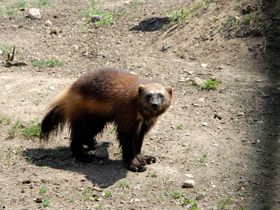















The American badger (Taxidea taxus)
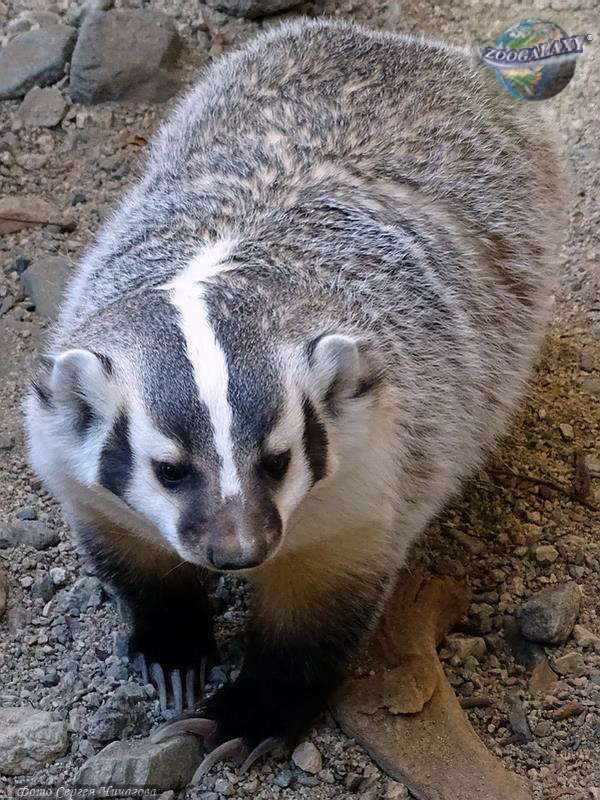


The American badger (Taxidea taxus) is a North American badger similar in appearance to the European badger, although not closely related. It is found in the western, central, and northeastern United States, northern Mexico, and south-central Canada to certain areas of southwestern British Columbia.
The American badger's habitat is typified by open grasslands with available prey (such as mice, squirrels, and groundhogs). The species prefers areas such as prairie regions with sandy loam soils where it can dig more easily for its prey.
Taxonomy
The American badger is a member of the Mustelidae, a diverse family of carnivorous mammals that also includes weasels, otters, ferrets, and the wolverine. The American badger belongs to the Taxidiinae, one of four subfamilies of mustelid badgers – the other three being the Melinae (four species in two genera, including the European badger), the Helictidinae (five species of ferret-badgers) and the Mellivorinae (the honey badger); the so-called stink badgers are mephitids. The American badger's closest relative is the prehistoric Chamitataxus. Among extant mustelids, the American badger is the most basal species; its lineage is thought to have split off from the rest of the Mustelidae about 18 million years (Ma) ago, following the split of mustelids from procyonids about 29 Ma ago.
The recognized subspecies include:
- Taxidea taxus taxus;
- Taxidea taxus berlandieri;
- Taxidea taxus jacksoni;
- Taxidea taxus jeffersonii;
- Taxidea taxus marylandica.
The ranges of the subspecies overlap considerably, with intermediate forms occurring in the areas of overlap.
In Mexico, this animal is sometimes called tlalcoyote. The Spanish word for badger is tejón, but in Mexico this word is also used to describe the coati. This can lead to confusion, as both coatis and badgers are found in Mexico.
Habitat area
Taxidea taxus is a species of the family Mustelidae (weasels and relatives), the only one of the genus Taxidea, (Nearctic equivalent of the European badger).
Taxidea taxus is distributed from southwestern Canada to central Mexico. Taxidea taxus inhabits arid and semi-desert scrub-covered areas (open grasslands, fields and pastures); it also occurs in montane forests and subalpine meadows (up to 3000 m altitude) and alpine tundra.
Appearance
Biologically, it is close to the common badger, although it belongs to a different genus. Its size is somewhat smaller: body length varies between 42 and 74 cm, tail length between 10 and 16 cm and weight between 10 and 12 kg. The body of Taxidea taxus is massive and muscular, its fur is long and rough, and its tail is short and strongly pubescent. Its long claws (up to 5 cm) and strong forelegs are excellently adapted for digging. Taxidea taxus is black underneath and grey or reddish above and on the sides, with black undulations. A narrow white stripe runs from the tip of the black nose along the head and back. The muzzle is spotted. Longevity: 4-5 years in the wild, up to 26 years in captivity.
Nutrition
This predator feeds on rodents (voles, squirrels, gophers, moles, skunks), snakes, eggs and chicks of ground-nesting birds, insects and their larvae, worms and carrion. Taxidea taxus also hunt rattlesnakes, whose delicate flesh is clearly to their liking. If the hunt is successful, they hide the surplus food in their den to eat it later.
Lifestyle
Taxidea taxus is mostly nocturnal, but is often seen during the day. It usually spends the daylight hours in a burrow that it digs itself. When digging in soft ground, the badger uses its claws and teeth, approaches an obstacle, burrows into the ground and disappears from sight for a few minutes. The badger often occupies old fox and coyote burrows to establish its den.
Burrows are used for a variety of purposes, depending on their complexity, depth and length: daytime roosting, winter sleep, incubation of young or storage of food reserves. Some dens are used as temporary dens, dug in case of unforeseen danger. A typical solitary Taxidea taxus burrow is a tunnel about 10 m long with a nesting chamber located about 3 m below the ground surface.
Taxidea taxus is very tidy, always hides its droppings and cleans itself frequently and thoroughly by licking its fur.
If the Taxidea taxus is "cornered" it can attack its enemy. Its thick, tough fur and strong neck muscles reliably protect it, it bites and scratches, and emits an unpleasant odour from its anal glands. In case of danger, the Taxidea taxus slowly retreats to the nearest burrow and, once reached, plugs the entrance hole from the inside. If there is no suitable burrow nearby, the animal quickly begins to dig it, throwing mud and soil in the attacker's face.
In the north of its range and in the mountains, the Taxidea taxus hibernates for days or weeks. During this time its body temperature drops and its pulse rate halves. Taxidea taxus usually closes the entrance to its burrow from the inside. In winter, it sometimes leaves its burrow for a short period of time, but does not go further than 250 m from its burrow.
Social behaviour and reproduction
Taxidea taxus is a territorial animal. The male's territory is surrounded by that of several females. Badgers do not defend the boundaries of their den, but defend their den from intruders.
Apart from breeding and rearing, this animal leads an isolated lifestyle.
The breeding season of Taxidea taxus runs from August to September. Pregnancy lasts up to 6 months. The female gives birth to 1-5 offspring (usually 2) in a nest that is located underground in a complicated burrow. The newborns are blind and helpless and are covered with sparse fur. The babies' eyes open in the fourth week. The mother feeds them with milk for about 6 weeks. Some females can become pregnant as early as 4-5 months of age, but usually only start breeding at two years of age.
Predation
While the American badger is an aggressive animal with few natural enemies, it is still vulnerable to other species in its habitat. Predation on American badger by golden eagles (Aquila chrysaetos), coyotes (Canis latrans) and bobcats (Lynx rufus) has been reported. Bears (Ursus spp.) and gray wolves (Canis lupus) occasionally kill American badgers, while cougars (Puma concolor), according to a 2019 study, apparently are the main predators of adults, hunting them much more frequently than the other carnivorans, with a documented case where the badger is one of the main prey of a radio-collared cougar.
American badgers are trapped by humans for their pelts. Their fur is used for shaving and painting brushes.
Conservation status
In May 2000, the Canadian Species at Risk Act listed each of the subspecies Taxidea taxus jacksoni and Taxidea taxus jeffersonii as an endangered species in Canada. The nominate subspecies was additionally deemed to be of "Special Concern" in November 2012. The subspecies Taxidea taxus jeffersonii, which resides in British Columbia, was subsequently divided into two populations, a western one in the Okanagan Valley-Cariboo region and an eastern one in East Kootenay, with each receiving an endangered listing. The Canadian population of Taxidea taxus jacksoni is isolated from other badgers in a small area of southwestern Ontario near the border with the United States south of the Niagara Peninsula, although a population may also exist in the northwest of the province.
The California Department of Fish and Game designated the American badger as a California species of special concern.