














The tammar wallaby (Notamacropus eugenii), the dama wallaby or darma wallaby
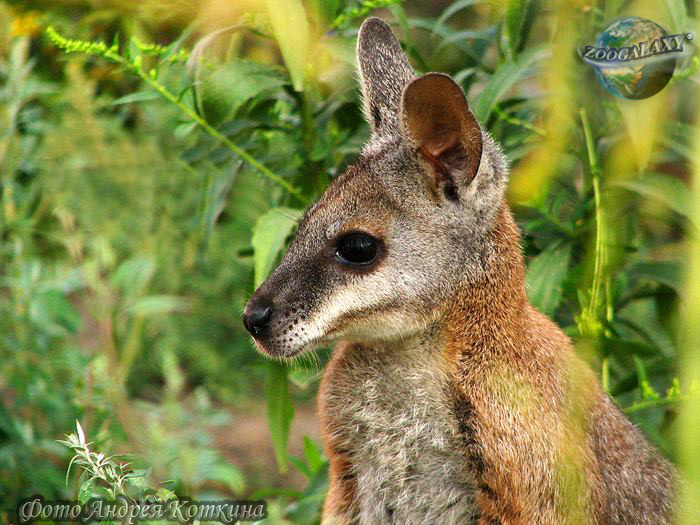
The tammar wallaby (Notamacropus eugenii), also known as the dama wallaby or darma wallaby, is a small macropod native to South and Western Australia. Though its geographical range has been severely reduced since European colonisation, the tammar wallaby remains common within its reduced range and is listed as "Least Concern" by the International Union for Conservation of Nature (IUCN). It has been introduced to New Zealand and reintroduced to some areas of Australia where it had been previously extirpated. Skull variations differentiate between tammar wallabies from Western Australia, Kangaroo Island, and mainland South Australia, making them distinct population groups.
The tammar wallaby is among the smallest of the wallabies in the genus Notamacropus. Its coat colour is largely grey. The tammar wallaby has several notable adaptations, including the ability to retain energy while hopping, colour vision, and the ability to drink seawater. A nocturnal species, it spends the nighttime in grassland habitat and the daytime in shrubland. It is also very gregarious and has a seasonal, promiscuous mating pattern. A female tammar wallaby can nurse a joey in her pouch while keeping an embryo in her uterus. The tammar wallaby is a model species for research on marsupials, and on mammals in general. Its genome was sequenced in 2011.
Taxonomy and classification
The tammar wallaby was seen in the Houtman Abrolhos off Western Australia by survivors of the 1628 Batavia shipwreck, and recorded by François Pelsaert in his 1629 Ongeluckige Voyagie. It was first described in 1817 by the French naturalist Anselme Gaëtan Desmarest, who gave it the name eugenii based on a specimen found on an island then known as Ile Eugene in the Nuyts Archipelago off South Australia, which is now known as St. Peter Island. The island's French name was given in honour of Eugene Hamelin, caption of the ship Naturaliste; whose name is now the specific name of the tammar wallaby. The common name of the animal is derived from the thickets of the shrub locally known as tamma (Allocasuarina campestris) that sheltered it in Western Australia. It is also known as the dama wallaby or darma wallaby.
The tammar wallaby is traditionally classified together with the kangaroos, wallaroos and several other species of wallaby in the genus Macropus, and in the subgenus Notamacropus with the other brush wallabies, all of which have a facial stripe. However, some authors have proposed elevating the three subgenera of Macropus, Macropus (sensu stricto), Osphranter, and Notamacropus into distinct genera, making the tammar's specific name Notamacropus eugenii. This has been supported by genetic studies.
Fossil evidence of the tammar wallaby exists from the Late Pleistocene Era – remains were found in the Naracoorte Caves. The mainland and island-dwelling tammar wallabies split from each other 7,000–15,000 years ago, while the South Australian and Western Australian animals diverged around 50,000 years ago. The extirpated tammar wallabies on Flinders Island were greyer in colour with thinner skulls than present-day Kangaroo Island tammars, which are in turn larger than the East and West Wallabi Islands animals. The island tammar wallabies were once thought to be a separate species from the mainland population.
A 1991 examination of tammar wallaby skulls from different parts of the species' range found that the populations can be divided into three distinct groups: one group consisting of the populations from mainland Western Australia, East and West Wallabi Islands, Garden Island and Middle Island; a second group consisting of the populations from Flinders Island, 19th-century mainland Southern Australia and New Zealand; and a third group consisting of the population from Kangaroo Island. The Western Australia Department of Environment and Conservation listed these populations as the subspecies Macropus eugenii derbianus, M. e. eugenii and M. e. decres, respectively.
A 2017 study found many genetic differences between tammars from Western and South Australia and comparably little between the Kangaroo island and introduced New Zealand tammars. The researchers proposed dividing the species into two subspecies; the subspecific name eugenii for South Australian tammars and derbianus for those from Western Australia.
Habitat
Macropus eugenii is one of the smallest of the genus Notamacropus. This marsupial has many names: tammar, damselfly kangaroo, Eugene philanthropist, Derby kangaroo and bush kangaroo. Macropus eugenii gets its Latin species name from the island of Ile Eugene, where it was first discovered. The kangaroo also occurs in Australia, New Zealand and several islands off the west and south coasts of Australia. Macropus eugenii lives in areas of dense vegetation with low trees and shrubs and in thickets at the forest edge.
Appearance
Macropus eugenii ranges in weight from 4 to 9 kg with a body length of 52 to 68 cm. There is considerable sexual dimorphism between males and females of this species, with males being distinctly larger. The maximum recorded weight of males is 9.1 kg, while that of females is only 6.9 kg. The body length of males is 59-68 cm, while that of females ranges from 52-63 cm. Both males and females are about 45 cm tall. The tail of males is 38-45 cm long, while that of females is 33-44 cm.
Males have much larger and longer forelimbs and wider claws than females. Macropus eugenii is a relatively small kangaroo species. It has a small head and large ears, and the tail is long and thick at the base. The hind legs are larger than the front legs and are specialised for hopping. This species is grey with a yellow abdomen and red legs. Like all marsupials, the female of this species has a leathery pouch on her abdomen in which she suckles her young.
Reproduction
Each female gives birth to one young at a time, after 25 to 28 days of gestation. In Macropus eugenii, the young are born in the embryonic stage of development. The newborn weighs less than 1 gram. After birth, the baby remains in the pouch for 8 to 9 months, until it develops physically. Weaning occurs at 10 to 11 months of age. The age of sexual or reproductive maturity of females averages 9 months, while males are about 2 years old.
Virtually all species of the kangaroo family have a unique reproductive characteristic, the so-called embryonic diapause. This phenomenon is also known as "delayed birth", because embryonic development is temporarily halted until the right conditions are met. A female nursing a calf in her pouch may also have a dormant embryo (diapause) in the uterus. Then, when the young kangaroo leaves the pouch and emerges to feed on its own, the embryo resumes its development.
Uterine gestation is very short and most of the embryo's development takes place in the pouch outside the uterus. The pouch contains nipples that ensure a continuous supply of milk to the developing baby. The male Macropus eugenii has a prolonged spermatogenesis compared to other mammals.
The birth process in Macropus eugenii begins when the newborn emerges from the cloaca and is released from the amniotic membranes. Instinctively, due to its sense of smell and gravity, it moves towards the pouch. Once inside the pouch, the newborn drops its mouth onto one of the teats, from which it receives the milk, rich in fats and nutrients. If for some reason it falls out before its warm nest, it will not be able to climb back up and will die. Unfortunately, there is not much the mother can do to help her in this case. Weaning occurs at 11 months of age and puberty begins at 1.5-2 years.
Social behaviour
Macropus eugenii live in groups of up to 50 individuals. Males compete with each other for the position of group leader. The area occupied by a group is 100 ha.
Macropus eugenii is a very social species. These kangaroos socialise, feed and live in groups with a hierarchical dominance structure. These groups are called "mobs". Males tend to have a higher rank. Dominance is determined by aggressive encounters, and the winner becomes the highest ranking male. Males fight each other until one of them proves to be the strongest. The strongest males gain high chances of mating with females and ultimately in reproduction.
The male's position in the hierarchy generally depends on size, which in turn is related to fighting ability. Males with greater height and more muscular forelimbs have a significant advantage over their rivals during their fights. The development of structures related to size and strength play an important role in the ritual of "displays", i.e. their exhibition by one male to another.
Demonstrations" are a series of postures or actions performed by individuals to impress and intimidate an opponent during an aggressive confrontation. In Macropus eugenii, demonstrations include a series of actions: adopting an upright posture, extending the chest and flexing the forearm to demonstrate the musculature of the outstretched arm at a distance.
Demonstration behaviour is also used as part of the courtship ritual. Males demonstrate dominance and rank to impress the bitch, to show their strength and superior physical condition. The fighting style of all kangaroos is to use their limbs to grab an opponent by the head, neck and shoulders. In addition, all kangaroos use their hind limbs to strike forward, while using their tails for balance and support.
Each group or herd of Macropus eugenii has an area of up to 100 hectares. This territory may overlap and be shared with other mobs in outlying areas. Mobs are made up of individuals of all ages and both sexes and usually have up to 50 members.
Lifestyle and nutrition
Macropus eugenii has a mainly nocturnal lifestyle. It has two natural enemies: dingoes and birds of prey. The wild Canis dingo captures and preys on Macropus eugenii. When attacked by a dingo, Macropus eugenii tries to position itself with its back against a tree trunk. It then tries to kick the Canis dingo with its forelegs and, finally, throwing its hind limbs forward, it tries to attack the belly of its enemy. A sharp, pointed blow from its hind limbs, or a wound caused by the sharp claws of the kangaroo, can seriously injure the Canis dingo.
Macropus eugenii is a herbivore that specialises in eating grass. Members of the kangaroo family have the characteristic ability to move their lower jaw back and forth, which increases the biting effect of their food. When feeding, Macropus eugenii sits or moves on all four limbs.
Macropus eugenii and humans
Economic importance to humans: Negative. Macropus eugenii damages crops, eats livestock feed and drinks scarce water, breaks and destroys hedgerows. The extent of its role as an agricultural pest was well documented in the early 1980s. Between 1983 and 1984, feed losses in sheep due to kangaroos and wallabies accounted for 51% of total agricultural losses.
Macropus eugenii is a very important animal used in scientific research. The species is used in research on human reproduction and sperm production in mammals. In addition, according to Jones Russell, Macropus eugenii is an animal model for research into the transport of androgens (hormones that stimulate the development of male sexual characteristics) to the reproductive organs. This research could have a profound impact on developmental areas of human biology. These animals were once hunted for their meat and fur.
Macropus eugenii has no conservation status. These kangaroos were introduced to previously uninhabited islands free of the species. Domestic livestock have played a role in altering the habitat of Macropus eugenii, reducing the natural vegetation of grasslands, making them unsuitable for the introduction of Macropus eugenii. Macropus eugenii continues to be controlled as a pest and continues to be harvested from the wild for commercial purposes. The use and demand for Macropus eugenii skins for leather goods is high, although the species is not well suited for this purpose.
The habitat of Macropus eugenii may also be affected by the introduction of new species. Rabbits were first introduced to Australia by European settlers and still wreak havoc today. Rabbit populations often reach staggering densities and their feeding on vegetation causes massive destruction of grasslands. Since their introduction, rabbits have been a threat to native wildlife, including Macropus eugenii.