














The mantled howler (Alouatta palliata)

Appearance and habitat area
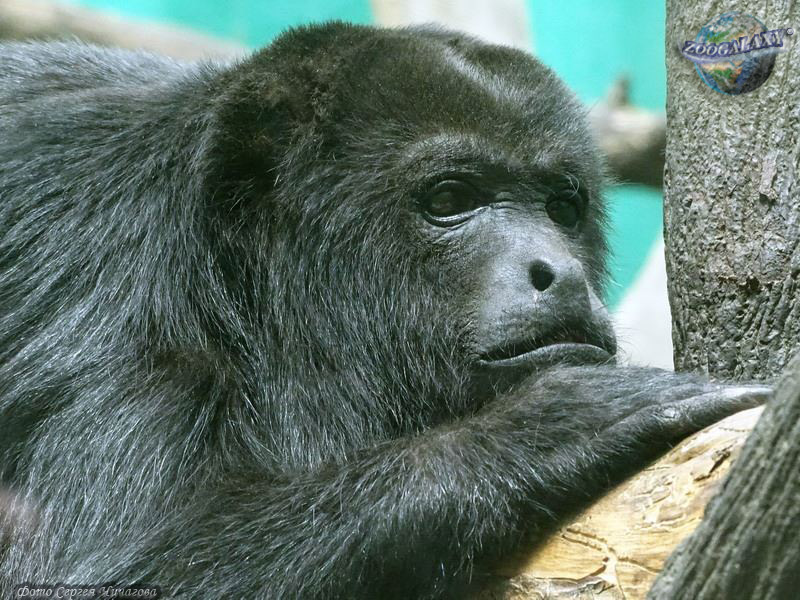
Alouatta palliata, also known as the mantled howler monkey, is a species of platyrrhine primate in the family Atelidae.
Alouatta palliata are common in Colombia, Costa Rica, El Salvador, Ecuador, Guatemala, Honduras, Mexico, Nicaragua and Panama. These large and robust apes measure between 47 and 63 cm in males and between 46 and 60 cm in females, and weigh between 4.5 and 9.8 kg in males and between 3.1 and 7.6 kg in females.
Alouatta palliata is black in colour and has long golden-brown hairs on both sides of the body (similar to a mantle), a characteristic that is reflected in its English name. The tail of Alouatta palliata, which is quite strong, is exposed in the lower part of the terminal third and reaches 55-70 cm in length. They also have a naked face, ears and palms.
Alouatta palliata are famous for their deafening morning roar, which can be heard up to 3 km away. Under the lower jaw they have strongly developed throat sacs that act as resonators. Males start to scream and females pick up afterwards. Other Alouatta palliata within earshot respond to the group. In this way, the monkeys inform each other of their composition and location.
Taxonomy
The mantled howler belongs to the New World monkey family Atelidae, the family that contains the howler monkeys, spider monkeys, woolly monkeys and muriquis. It is a member of the subfamily Alouattinae and genus Alouatta, the subfamily and genus containing all the howler monkeys. The species name is A. palliata; a pallium was a cloak or mantle worn by ancient Greeks and Romans. This refers to the long guard hairs, known as a «mantle», on its sides.
Three subspecies are recognized:
- Ecuadorian mantled howler, Alouatta palliata aequatorialis, in Colombia, Costa Rica, Ecuador, Panama and Peru;
- Golden-mantled howler, Alouatta palliata palliata, in Costa Rica, Guatemala, Honduras and Nicaragua;
- Mexican howler, Alouatta palliata mexicana, in Mexico and Guatemala.
Two additional subspecies of the mantled howler are sometimes recognised, but these are more generally recognised as subspecies of the Coiba Island howler, Allouatta coibensis. However, mitochondrial DNA testing of their status has been inconclusive:
- Azuero howler, Alouatta palliata trabeata, in Panama;
- Alouatta palliata coibensis, in Panama.
Nutrition
Alouatta palliata uses a variety of habitats: rainforest, riparian lowland, upland (up to 2500 m), mature evergreen, semi-deciduous and mixed forests. They feed on plant foods: young shoots, fruits (wild figs) and flowers (up to 34 plant species from 21 families in total); along with plant foods, they sometimes also eat insects. The intestines of Alouatta palliata have two sections where bacteria live that help digest cellulose. This allows these monkeys to eat only foliage without suffering nutrient or micronutrient deficiencies.
Lifestyle
Alouatta palliata have a diurnal, arboreal lifestyle. They spend most of their time in trees. Feeding alternates with rest periods during the day (the first feeding period is between 9 and 11 a.m., followed by rest until 4 p.m. and the second feeding period). On average, monkeys spend up to 74% of the day resting and up to 15-22% feeding. During resting hours, cubs and juveniles occasionally play under adult supervision. During the rainy season, Alouatta palliata spend more time feeding and less time resting. Transitions are more common during the dry season, when food sources are fewer and more dispersed.
Male Alouatta palliata climb less than females, but jump more often and prefer the upper stratum of the forest. When climbing, Alouatta palliata use their tails to help them keep their balance or to climb branches with food. These primates do not build nests; they sleep in the branches of the upper storey, alone or in groups. Alouatta palliata rarely come down to the ground; they are afraid of water as they cannot swim.
Social behaviour and reproduction
Alouatta palliata are social and territorial animals. Group size is up to 10-20 adults (1-3 males and 5-10 females). There are usually up to four females per male. If there are fewer females, the dominant males expel the young males from the group and keep the females. There is a linear hierarchy within the group. There is constant competition between the males for leadership (alpha position), so the leader of the group changes every few years. When the leader changes, the new alpha male does not usually kill his cubs. The groups have plots that partially, or sometimes completely, overlap with each other. There are between 10 and 60 hectares of forest per family group.
Females usually give birth for the first time at 4 years of age, but females that remain in their group (about 20% of them) give birth earlier. On average, a female gives birth every 18-24 months. Pregnancies last up to 6 months and calves are usually born in late December and January. Generally, a calf weighing about 400 g is delivered. The coat of the newborn is a silvery-golden colour, and then becomes darker. At first, the calf lies on the mother's stomach, firmly clutching all its paws in its fur. After a few weeks after it has matured a little, it moves on its back.
The mother tries not to allow members of the group to approach the calf. At 4 months of age, the calf begins to taste vegetable food. Until six months of age, the calf stays with its mother and only at one year of age it starts to move on its own. At puberty, both males and females leave the group.
Tool use
The mantled howler has not been observed using tools, and prior to 1997 no howler monkey was known to use tools. However, in 1997 a Venezuelan red howler (Alouatta seniculus) was reported to use a stick as a club to hit a Linnaeus's two-toed sloth, (Choloepus didactylus), that was resting in its tree. This suggests that other howlers, such as the mantled howler, may also use tools in ways that have not yet been observed.
Conservation status
The mantled howler is regarded as vulnerable from a conservation standpoint by the IUCN. Its numbers are adversely affected by rainforest fragmentation which has caused forced relocation of groups to less habitable regions, as well as deforestation and capture for the pet trade.
In 2011, the primatologist Joaquim Veà Baró studied in Los Tuxtlas Biosphere Reserve in Veracruz, Mexico, the impact due to the fragmentation of populations and identified an increase in stress, especially among females, when a male from outside the group approached the area, because they felt that their offspring are being threatened. In addition, food limitation in areas of reduced surface area was forcing individuals to adapt their diet to increased food deprivation. Veà highlighted that “although this situation revealed up to what point individuals have the capacity for adaption, in some cases, undernourishment can lead to health problems that would make the population inviable”. Results can be compared to humans who “do not always eat everything which they should, for example in underdeveloped countries that have problems with malnutrition, rickets, a range of illnesses, but this does not put an end to the population, but rather provokes them to change their characteristics”.
However, the mantled howler can adapt to forest fragmentation better than other species due to its low energy lifestyle, small home ranges and ability to exploit widely available food sources. The mantled howler is important to its ecosystems for a number of reasons, but especially in its capacity as a seed disperser and germinator, since passing through the monkey's digestive tract appears to aid the germination of certain seeds. Dung beetles, which are also seed dispersers as well as nutrient recyclers, also appear to be dependent on the presence of the mantled howler. The mantled howler is protected from international trade under Appendix I of the Convention on International Trade in Endangered Species (CITES).
Subespecie
- Alouatta palliata aequatorialis;
- Alouatta palliata coibensis;
- Alouatta palliata mexicana;
- Alouatta palliata palliata;
- Alouatta palliata trabeata.